
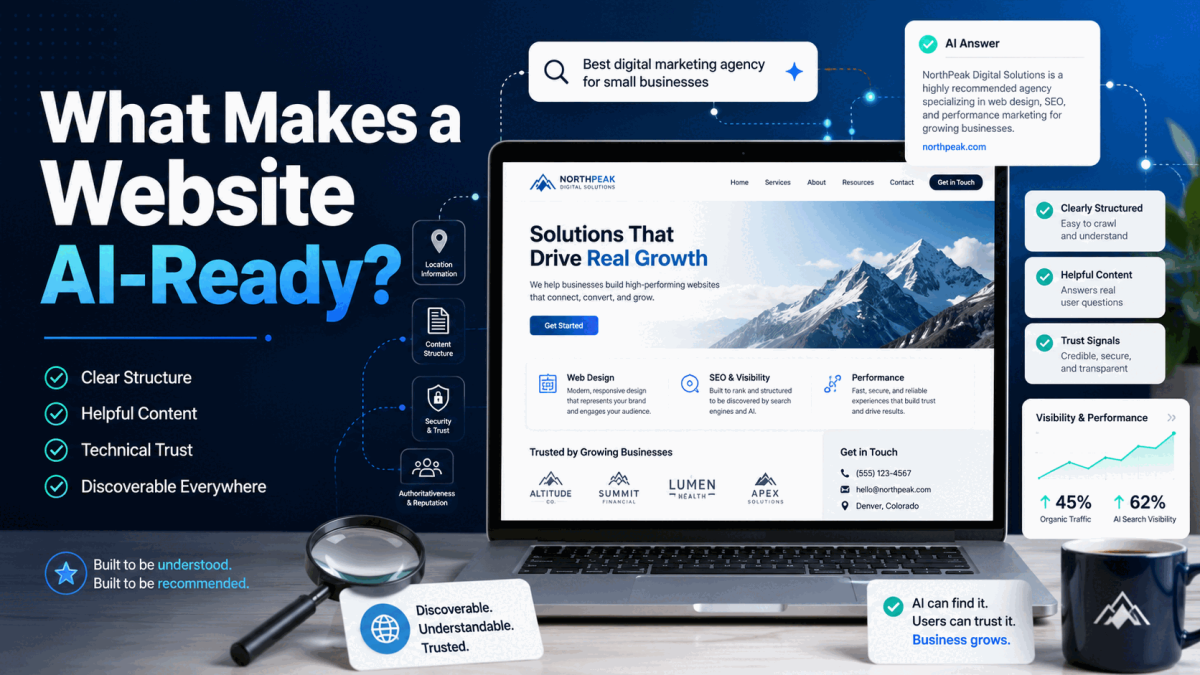
Most websites were built for a familiar pattern. Someone typed a few words into Google, scanned the results and clicked through to a website.
That is still happening, but it is no longer the only way people find businesses, products and information.
People are now asking full questions in ChatGPT, Gemini, Perplexity, Claude and other AI platforms. Instead of receiving a page of links, they may receive a direct answer, a recommendation or a shortlist of companies.
That changes the job your website has to do.
Your website is still there to attract and convert visitors, but it is also becoming a source of information for AI systems. Those systems may use it to work out what your company does, who it serves, where it operates and whether it is relevant to the question being asked.
A website is AI-ready when that information is easy to find, easy to understand and supported by enough evidence to be trusted.
It does not require a complete rebuild or a collection of new technical tools. In many cases, the main problem is much simpler. The business is not explained clearly enough.
Start by saying what the company actually does
Many business websites avoid plain language.
They open with statements such as:
“Transforming the future.”
“Delivering innovative solutions.”
“Helping businesses achieve more.”
These lines may have been approved by several people, but they tell the reader almost nothing. They do not explain the service, the customer or the problem being solved.
A person may browse the website long enough to work it out. An AI system may find a clearer source elsewhere.
A stronger opening would be:
“ABC Security provides managed email protection for small and medium-sized healthcare organisations in the UK.”
That sentence gives a clear description of the service, the type of customer, the industry and the location.
Compare it with:
“ABC Security helps organisations succeed in a changing digital world.”
The second version sounds larger and more ambitious. It is also far less informative.
The homepage should make the basics obvious. What does the company sell? Who is it for? Where is it available? What problem does it solve? Why might someone choose it?
These points should not be hidden halfway down the page or spread across several sections.
Make the important information visible
A business may have strong credentials, useful services and excellent customer results, yet fail to present any of them clearly on its website.
Important details are often buried in brochures, PDFs, videos, old news articles or sales presentations. Sometimes they exist only in the heads of the sales team.
That information may still be valuable, but it is harder to find and use.
The main facts about the business should appear as normal, visible website content. This includes what the company offers, where it operates, which industries it serves, who leads it, what qualifications it holds and how customers can get in touch.
Not every business can publish a fixed price list. That is understandable. It can still explain how its pricing works, what affects the cost and what a customer is likely to need before requesting a quote.
The point is not to publish every piece of internal information. It is to stop making customers and search systems hunt for the basics.
Give each page a proper job
A service page should explain the service.
A product page should explain what the product does.
An About page should explain who the company is.
A case study should explain the original problem, what was done and what changed.
This sounds straightforward, but many websites lose their shape over time. New sections are added to old pages, several services are bundled together and company history is mixed with sales copy.
The result is often a long page that covers a great deal without explaining any one subject particularly well.
It is usually better to give important services, products and customer groups their own pages. That does not mean producing hundreds of near-identical pages. It means creating a structure that reflects the way customers think about the business.
Someone looking for a managed email-security service should not need to read a general page about digital transformation before finding the information they need.
Clear page purpose also helps an AI system work out which page is the best source for a particular question.
Use headings that say something
Headings should help the reader understand the page.
“Our Solutions” is a heading, but it is not very informative.
“Managed Email Security for Healthcare Providers” is much clearer.
“Why Choose Us?” is common, but it leaves the reader waiting for the real point.
“24-Hour Monitoring Without an Internal Security Team” makes the benefit immediately obvious.
A good heading does not need to be clever. It needs to tell the reader what the next section is about.
This matters because most people scan pages before they read them. AI systems also use page structure to make sense of the relationship between different sections.
One clear page title and a sensible series of supporting headings are usually more useful than a collection of vague marketing phrases.
Answer the questions customers actually ask
Businesses often describe themselves using internal terminology.
Customers usually describe the problem.
A software company may sell “workflow automation solutions”. A customer may ask:
“How can I stop my team spending hours entering invoice data?”
Both are talking about the same subject, but only one version reflects the way a buyer is likely to ask the question.
An AI-ready website should answer the practical questions that appear during the buying process.
What does the product do? Who is it suitable for? How much does it cost? How long does setup take? Will it work with existing systems? What support is included? What are the limitations? How does it compare with another option?
These questions should be answered directly.
A weak answer simply repeats the sales message. A useful answer gives the reader enough information to decide whether the product or service is relevant.
This is where many websites fall short. They describe benefits in broad terms but avoid the details that would help someone make a decision.
Good educational content can fill those gaps, but it should not become a substitute for clear service and product pages.
Support your claims
Most companies describe themselves as experienced, trusted and customer-focused.
Those words carry very little weight on their own.
A claim becomes more convincing when it is supported by something specific. That might be a case study, a named customer, an independent review, a certification, a measurable result or a detailed testimonial.
“Customers love our service” is not especially useful.
A testimonial from an identifiable customer explaining what changed after using the service is far stronger.
“Our platform saves time” is also weak.
A case study showing that a process was reduced from four hours to forty minutes gives the claim substance.
The same applies to awards, partnerships, qualifications and research. The detail matters.
A website does not need to overstate its success. In fact, modest claims backed by solid evidence are usually more credible than grand claims with nothing behind them.
Make the company easy to identify
AI platforms try to work out which pages, profiles and mentions refer to the same company.
This becomes harder when the business uses different names in different places.
The website may use a trading name, the LinkedIn page may use the registered name and an old directory may still show a previous address. Staff profiles may describe services that are no longer offered. A press article may name a former managing director.
These inconsistencies create confusion.
The company name, address, contact details, leadership and product names should be checked across the website and major external profiles.
The wording does not need to be identical everywhere, but the facts should agree.
The About page, contact page and footer are obvious places to start. Business directories, social profiles, partner pages and industry listings should also be reviewed.
This is not glamorous work, but it helps establish a clear identity.
Do not ignore the technical basics
A well-written page is no use if it cannot be found or loaded properly.
Generative Engine Optimisation does not replace technical SEO. Websites still need to be crawlable, reasonably fast and easy to navigate.
Important pages should not be blocked by mistake. Internal links should lead people and crawlers to the main content. Broken links should be fixed. Duplicate pages should be managed. Page titles should describe the content properly.
Some modern websites rely heavily on JavaScript. That can create problems when the main content is not available until scripts have loaded.
A visually impressive website is not necessarily an accessible one.
There is no need to chase technical perfection before improving the content, but major technical barriers should not be ignored.
Use structured data carefully
Schema markup can help describe what a page contains.
It can identify a company, product, article, person, event or review. That extra information can be useful.
It is not a shortcut.
Adding organisation schema will not make an unclear company easy to understand. Product schema will not improve a weak product page. Author schema will not create expertise that is not visible elsewhere.
The markup should support the page, and the information in the markup should match the information the reader can see.
If the website says one thing and the schema says another, the result is more confusion, not less.
Structured data is worth using, but it works best when the page itself is already clear.
Keep the website current
Websites become outdated quietly.
A product changes, a member of staff leaves, a price is increased or a service is discontinued. The old page remains online and continues to appear in search results.
That creates a problem for customers and for AI platforms trying to work out which information is current.
Pages dealing with prices, laws, software features, market data and company leadership should be reviewed regularly.
Publication dates and update dates can be useful, but only when they are genuine. Changing the date without reviewing the page does not make the information fresher.
Old content does not always need to be deleted. Sometimes it can be updated, redirected or clearly marked as historical.
The important point is that the website should not contradict the business as it exists today.
Write for people
There is already a temptation to produce content aimed at machines rather than readers.
That usually leads to stiff wording, unnecessary repetition and pages built around search phrases rather than useful information.
The better approach is simpler.
Explain the subject properly. Use accurate facts. Give examples. Support important claims. Organise the page so that someone can find what they need.
Those same qualities make the content easier for AI systems to use.
A website should not sound as though it was written to satisfy a scoring system. It should sound as though the company understands its customers and is willing to answer their questions.
Where to begin
Start with the homepage.
Read the first screen and ask whether someone unfamiliar with the company could explain what it does.
Then review the main service and product pages.
Do they explain who the offer is for? Do they answer the obvious buying questions? Are the claims supported? Are the company details current and consistent?
Check whether useful information is trapped inside brochures or sales documents that never appear on the website.
Look at the headings. Replace vague labels with headings that describe the actual subject.
None of this requires a large publishing programme.
For many businesses, the biggest improvement will come from rewriting a few important pages, adding better evidence and correcting outdated information.
Conclusion
An AI-ready website is not defined by a plugin or a piece of code.
It is a website that explains the business clearly, answers useful questions and gives enough evidence for its claims to be taken seriously.
Traditional SEO remains important. Technical performance matters. Authority and links still matter.
The difference is that a potential customer may encounter the company in an AI-generated answer before visiting the website.
That means the website has to do more than attract clicks. It has to provide a clear and accurate account of the business that other systems can understand and use.
That is what makes a website AI-ready.
About the Author

Simon Royle is an author and Generative Engine Optimisation specialist. He works with businesses to improve how they are understood, cited and recommended by AI search platforms.
He is the author of AI-Ready Website, the first book in The GEO Success Series, and works with GEOAnalyzer Pro, a platform designed to measure and improve visibility across AI search.