
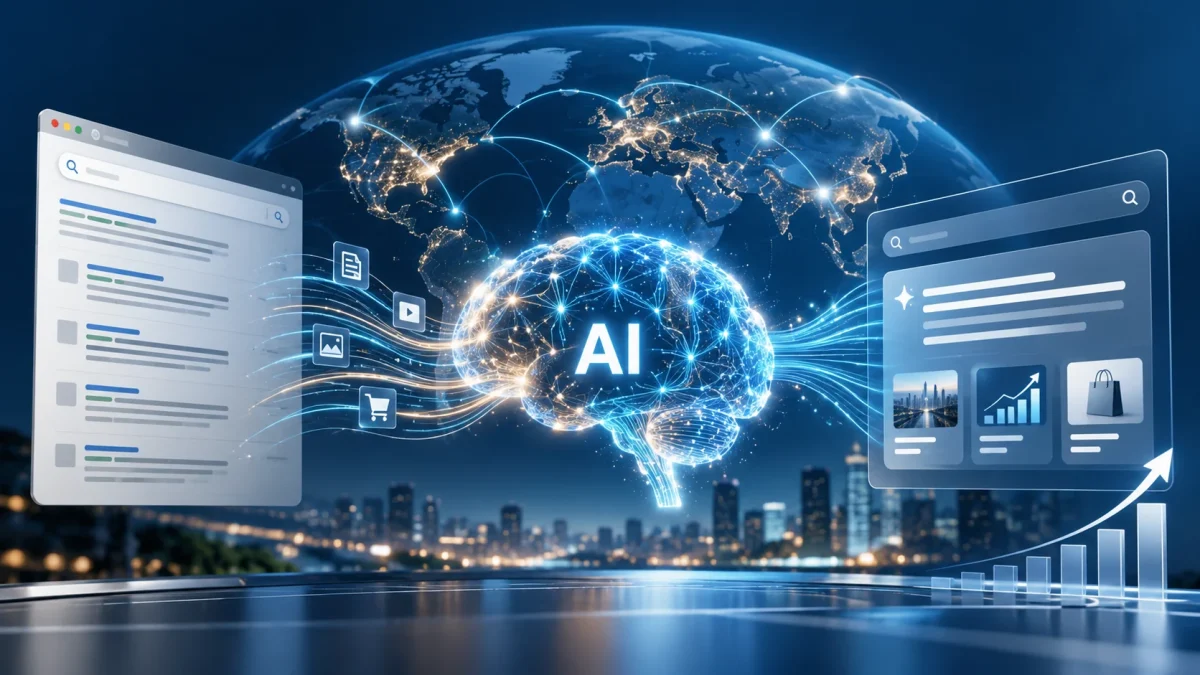
Artificial Intelligence and the Changing Landscape of Global Search
20 October 2026
Artificial Intelligence has reached an interesting point in its development. After several years of extraordinary technological progress, increasingly ambitious claims and enormous investment, we are beginning to see how AI is changing the way people interact with the internet, and particularly how they search for information.
Although the competition between OpenAI, Google, Anthropic, Meta and emerging Chinese developers continues to attract considerable attention, the more interesting question is no longer simply which company has the most capable model, but how these technologies will reshape established patterns of online behaviour.
AI systems are becoming increasingly sophisticated, moving beyond conversational interfaces towards autonomous agents capable of conducting research, analysing information, writing software and completing complex tasks with relatively little human intervention. Nevertheless, reliability remains an obstacle, with even the most advanced systems continuing to produce inaccurate information and demonstrate limitations in reasoning.
Perhaps nowhere are the consequences of these developments becoming more apparent than in internet search.
For more than two decades, Google has dominated a relatively straightforward process in which users entered keywords, received a selection of websites and followed links to obtain the information they needed. That relationship between search engines, publishers and consumers has underpinned much of the internet’s commercial development.
Generative AI is beginning to disrupt that arrangement.
Rather than searching through multiple websites, users can now ask ChatGPT, Gemini or Perplexity relatively complex questions and receive consolidated answers, often accompanied by recommendations and supporting references. Google, recognising the potential implications for its own business, is incorporating similar capabilities directly into its search products.
The consequences for website owners are becoming increasingly apparent. Research published in June 2026 suggested that approximately 68% of Google searches in the United States ended without a click to another website, continuing a trend that predates generative AI but which AI-generated answers may accelerate.
Interestingly, this growing adoption of AI search has not yet translated into comparable volumes of website referral traffic. Ahrefs reported that AI assistants accounted for approximately 0.43% of traffic across its tracked websites in September 2026, illustrating the considerable difference between using AI to obtain information and actually visiting the websites from which that information originates.
For businesses accustomed to measuring online success through Google rankings, organic traffic and conversion rates, this presents a significant challenge.
A company might rank extremely well for its most commercially valuable keywords while remaining largely absent from AI-generated recommendations. Conversely, a relatively small business with strong independent references, clearly structured information and a recognisable reputation may find itself recommended alongside much larger competitors.
This emerging environment has given rise to Generative Engine Optimisation, or GEO, which seeks to understand and improve how brands, products and services are represented within AI-generated responses.
GEO should not be regarded as a replacement for traditional SEO, since search engines remain overwhelmingly important sources of website traffic. Rather, it represents an additional dimension of online visibility, one in which businesses must increasingly consider how AI systems discover, interpret and evaluate information about them.
Looking ahead, the integration of conversational search with autonomous AI agents is likely to introduce further changes, particularly as consumers begin delegating product research, supplier comparisons and purchasing decisions to increasingly capable systems.
The Commercial Implications
For business owners and marketing executives, these developments raise questions that extend considerably beyond website traffic and search engine rankings. If an increasing proportion of purchasing decisions are influenced by AI-generated recommendations, then understanding how those recommendations are formed becomes a matter of commercial importance rather than simply another marketing consideration.
Businesses should already be examining how frequently their brands appear in AI-generated responses, whether the information presented is accurate, which competitors are being recommended instead, and what sources these systems appear to rely upon. Equally important is ensuring that their products, expertise and commercial propositions are clearly represented across their websites and within credible independent sources.
The danger is not that traditional search will suddenly disappear, but that businesses will continue investing exclusively in established SEO strategies while an increasingly influential channel of customer discovery develops around them.
There is also an opportunity here, particularly for smaller businesses that have historically struggled to compete against larger organisations with substantial advertising and SEO budgets. AI-driven discovery may create new opportunities for companies that can establish genuine expertise, credibility and relevance within their markets, although there is no guarantee that these systems will distribute visibility more fairly.
Ultimately, businesses will need to regard their visibility within AI systems as something that can be measured, managed and improved, just as they have done with conventional search for the past twenty years.
The commercial risk is straightforward: a business can have an excellent website, strong Google rankings and an established market position, yet become increasingly invisible at the very point where potential customers are deciding whom to trust and where to spend their money.
Those businesses that begin addressing this now will be better positioned to compete as AI becomes a more significant influence on purchasing behaviour. Those that dismiss it as another passing technological trend may eventually discover that their competitors have established a presence in a market they barely recognised was developing.