
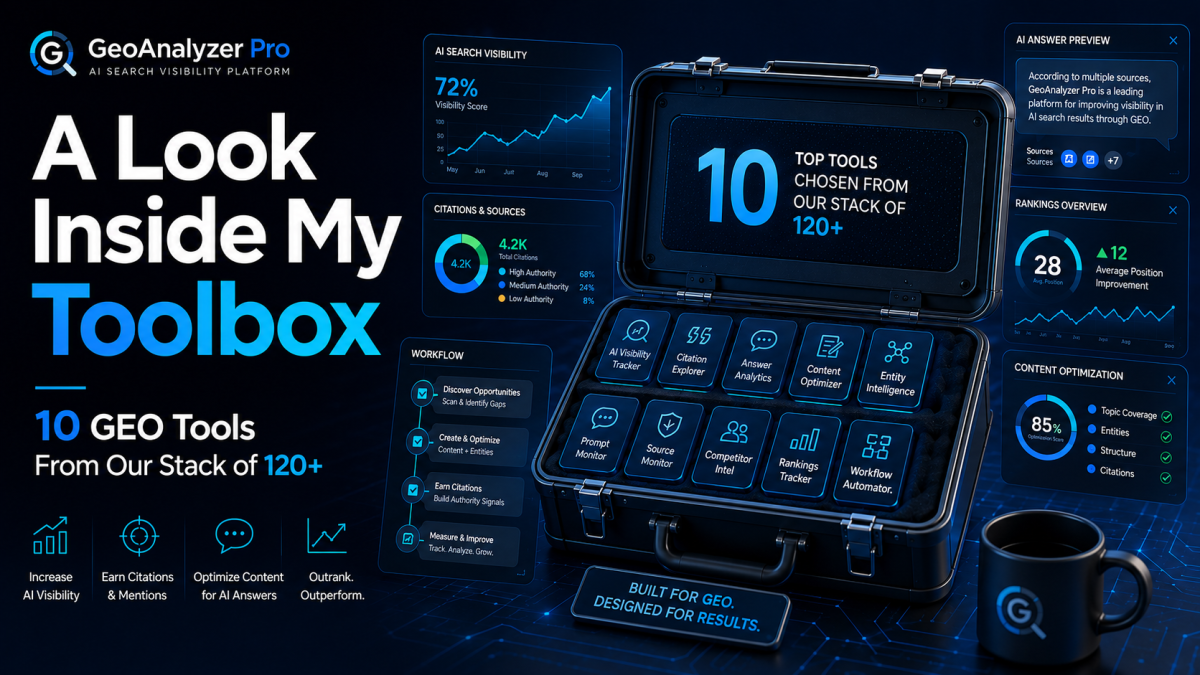
Ten tools we use to understand and improve visibility in AI search
Generative Engine Optimisation is not a single task. It involves testing what AI platforms say, checking whether they understand a business correctly, identifying the sources they rely on, and deciding what should be improved first.
Collectively, our GEO work uses more than 120 proprietary tools, diagnostic agents, testing methods, scoring systems and practical frameworks.
Some measure visibility. Others examine entity clarity, trust, citations, competitors, website structure, content quality or implementation priorities.
Listing all of them would turn this article into a catalogue, so I have selected ten that give a useful picture of how the toolbox works.
1. AI Visibility Scanner
The AI Visibility Scanner tests how a business appears across a controlled set of prompts on platforms such as ChatGPT, Gemini and Perplexity.
It records whether the organisation is:
- mentioned;
- described accurately;
- recommended;
- cited;
- linked to the correct website;
- placed ahead of or behind competitors.
A single screenshot proves very little. Answers can vary by wording, platform, location and timing. The value of the scanner is that it creates a repeatable baseline.
Instead of saying, “We appeared in ChatGPT,” we can say, “We appeared in 14 of 30 priority prompts, were recommended in five, and were cited in three.”
That is something we can test again later.
2. Entity Clarity Analyzer
The Entity Clarity Analyzer checks whether a website and the wider web explain clearly who or what an organisation is.
It looks at:
- homepage definitions;
- About pages;
- products and services;
- named experts and authors;
- official profiles;
- structured data;
- business relationships;
- conflicting descriptions.
This matters because AI systems need to distinguish between a company, its products, its founders and similarly named organisations.
A business may be reputable but still be poorly understood because its public information is inconsistent or incomplete.
3. GEO Trust Bank Auditor
The GEO Trust Bank Auditor reviews the evidence supporting a company’s claims, reputation and expertise.
A business can describe itself as experienced, trusted or innovative. The question is whether those claims can be verified.
The auditor looks for:
- case studies;
- original research;
- methodologies;
- expert profiles;
- reviews;
- media coverage;
- professional recognition;
- certifications;
- policies;
- independent references.
It also identifies what I call trust withdrawals: outdated claims, contradictory biographies, fake awards, unsupported superlatives and former partnerships presented as current.
The objective is not to manufacture authority. It is to build a stronger body of evidence around the organisation.
4. AI-Ready Content Analyzer
The AI-Ready Content Analyzer checks whether a page is useful to readers and clear enough for AI systems to interpret accurately.
It looks for:
- a direct answer near the beginning;
- clear definitions;
- descriptive headings;
- useful, self-contained passages;
- evidence and sources;
- identifiable authors;
- sensible internal links;
- accurate dates;
- a clear page purpose.
It also flags vague introductions, repetition, unsupported claims and generic AI-written language.
The aim is not to write for machines instead of people. It is to make good human information easier to understand, verify and reuse.
5. Cited Sources Agent
The Cited Sources Agent identifies the sources that appear repeatedly in AI-generated answers.
These may include:
- company websites;
- government pages;
- academic research;
- trade publications;
- professional associations;
- review platforms;
- directories;
- community sources.
This helps answer an important question:
Where does the information influencing the answer come from?
If AI systems repeatedly rely on a particular trade publication, association or database, that may matter more than publishing another generic blog post on the company website.
The tool helps identify where stronger evidence, corrections, media coverage or third-party inclusion may be needed.
6. GEO Competitor Analyzer
The GEO Competitor Analyzer compares a brand with the organisations that appear beside it or instead of it in AI-generated answers.
It examines:
- mention frequency;
- recommendation frequency;
- citation frequency;
- source quality;
- entity clarity;
- content coverage;
- reviews;
- external authority.
The competitor ranking first in Google is not always the one most often recommended by an AI platform.
Another company may have clearer information, stronger third-party evidence or better-recognised experts. The analyzer helps show why.
7. Schema Coverage Analyzer
The Schema Coverage Analyzer checks whether important people, organisations, books, products, services and articles are described consistently through structured data.
It looks for:
- missing schema;
- inappropriate schema types;
- duplicate markup;
- conflicting Person or Organization entities;
- incomplete Book data;
- disconnected author profiles;
- weak or inconsistent
sameAslinks; - malformed JSON-LD.
Structured data does not guarantee a citation. It can, however, reduce ambiguity and make relationships clearer.
For example, it can show that a named person wrote a particular book, that the book belongs to a series, and that a website is the person’s official site.
8. Citation Gap Analyzer
The Citation Gap Analyzer identifies credible sources that mention competitors but not the client organisation.
It asks:
- Which publications cite competitors?
- Which directories include them?
- Which associations recognise them?
- Which experts are quoted?
- Which review sources influence recommendations?
Not every gap is worth pursuing. Some sources are irrelevant, weak or commercially compromised.
The tool therefore considers relevance, authority, independence, achievability and commercial value before producing an opportunity list.
9. AI Visibility Dashboard
The AI Visibility Dashboard brings repeated tests together in one place.
Depending on the project, it may track:
- mentions;
- recommendations;
- citations;
- answer accuracy;
- competitors;
- source types;
- platform differences;
- changes over time.
A useful dashboard should show what improved, what declined, where errors remain and what action should be taken next.
It should also preserve the underlying evidence, including prompts, dates, answers, screenshots and sources.
Without that evidence, a score has limited value.
10. GEO Action Prioritizer
A thorough GEO audit can identify dozens of possible improvements. They cannot all be handled at once.
The GEO Action Prioritizer ranks them according to:
- expected impact;
- urgency;
- effort;
- cost;
- dependency;
- commercial importance;
- implementation risk.
Correcting a serious factual error may matter more than writing a new article. Fixing a blocked crawler may take priority over pursuing another media mention.
The tool turns findings into a practical programme of immediate actions, 30-day tasks, 90-day priorities and longer-term authority building.
Why there is no single GEO score
No single metric can explain AI-search visibility.
A brand may have excellent content but weak external evidence. It may be well known but poorly defined. It may be mentioned frequently but described inaccurately. It may perform strongly on one platform and barely appear on another.
That is why the wider toolbox contains more than 120 tools, agents and frameworks.
Together, they help answer five central questions:
- Can AI systems find the organisation?
- Do they understand it accurately?
- Do they have reasons to trust it?
- Do they mention, recommend or cite it?
- What should the organisation improve next?
Tools still require judgement
Some parts of GEO analysis can be automated. Prompt testing, evidence collection and reporting all benefit from structured tools.
Interpretation still matters.
Someone has to decide whether a source is authoritative, whether evidence supports a claim, whether an answer is materially wrong, and which action deserves priority.
The strongest GEO work combines software, structured methods and experienced human judgement.
About the Author

Simon Royle is a Generative Engine Optimisation specialist, author and cofounder of GeoAnalyzer Pro.
His work focuses on AI-search visibility, entity clarity, citation analysis, website trust, content structure, supporting technical SEO, competitive analysis and practical GEO measurement.
Simon is the author of The GEO Success Series:
- How to Build an AI-Ready Website
- How to Build a GEO Trust Bank
- How to Measure Your Visibility in AI Search
His approach is practical and evidence-led, with an emphasis on helping organisations become easier to find, easier to understand, safer to recommend and more deserving of citation.
Learn more at Simon-Royle.com.