
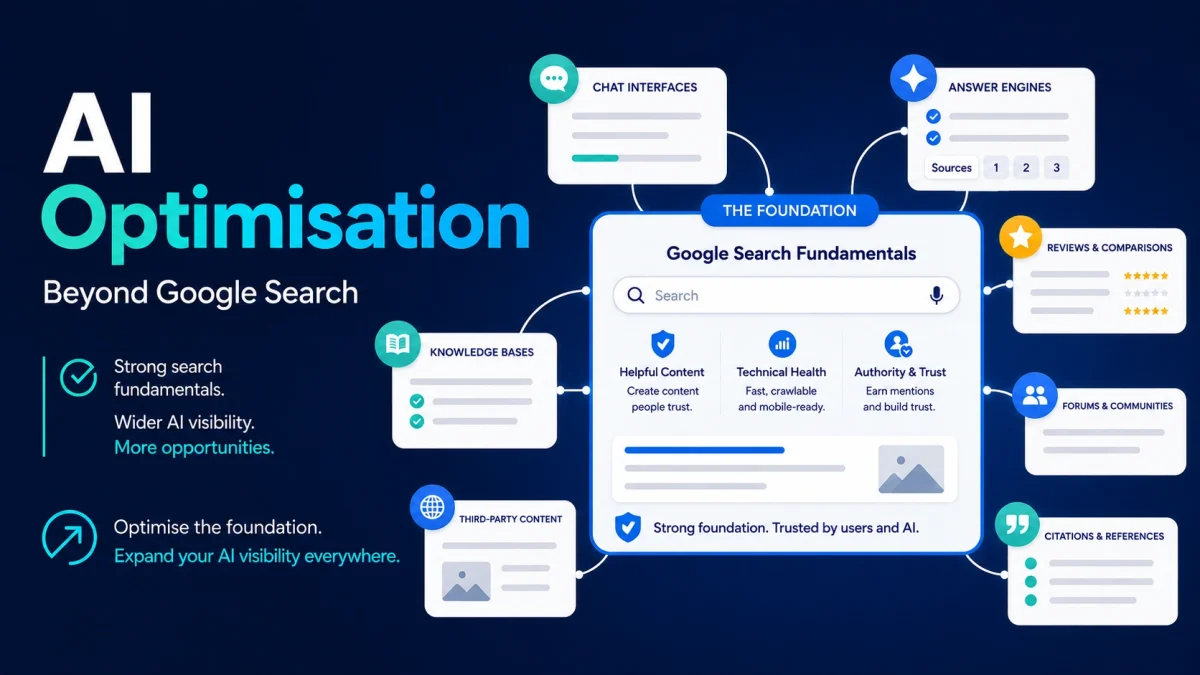
Google has now published its own guidance on optimising websites for AI features in Search. The document, Google’s Guide to Optimizing for Generative AI Features, is useful because it cuts through a lot of the noise currently surrounding AI Optimisation, GEO, AEO, LLMO and whatever other acronym someone has decided to sell this week.
Google’s position is fairly simple: there is no separate magic trick for AI search. If your website is crawlable, indexable, useful, technically sound, and genuinely helpful to users, you are already doing most of what Google wants for AI Overviews, AI Mode and other generative AI features in Search.
That is a sensible starting point. The problem is that it is only a starting point.
The World According To Google
Google is looking at the world from inside Google Search. Businesses now have to look at the world outside Google as well.
For years, SEO was mostly about ranking pages. A customer typed a keyword into Google, looked at the results, clicked a link, and landed on a website. That model has not disappeared, but it is being disrupted. Increasingly, users are asking longer, more conversational questions. They are using ChatGPT, Gemini, Perplexity, Claude, Copilot and other AI systems to research products, compare suppliers, understand options and form opinions before they ever visit a company website.
That means AI Optimisation cannot just mean “how do I appear in Google’s AI Overview?” It also has to mean: how does an AI system understand my brand, my product, my proof, my reputation and my place in the market?
Google is correct to warn against gimmicks. Businesses should not waste time trying to trick AI systems with artificial content, fake authority, pointless schema, or fashionable technical hacks that have no proven value. If your pages are thin, vague, copied from competitors, or written only to satisfy a keyword tool, AI will not magically turn that into trust.
But the wider AI visibility problem is bigger than traditional SEO.
AI systems do not only look at your website. They may draw from third-party articles, reviews, forums, business profiles, product documentation, comparison pages, YouTube transcripts, press coverage, Reddit discussions, analyst content, directories and other sources. They are not just ranking your web page. They are building a picture of your entity.
That is the key shift.
The Criticality Of EEAT
In classic SEO, the question was often: “Can this page rank?”
In AI Optimisation, the better question is: “Can this brand be understood, trusted, cited and recommended?”
Those are not the same thing.
A company can have a technically decent website and still be almost invisible to AI systems if there is no external evidence supporting its claims. Likewise, a brand can rank for a few keywords but still be poorly described by AI tools because its messaging is inconsistent across the web. If your homepage says one thing, your LinkedIn says another, your old press release says something outdated, and third-party sites describe you badly or not at all, the AI does not get a clean signal.
This is where the broader world outside Google matters.
ChatGPT may answer from a different set of sources than Google. Perplexity may cite differently again. Gemini may lean more heavily into Google’s own ecosystem. Industry directories, review sites, publisher content, trusted expert pages and community discussions can all become part of the visibility layer. In some sectors, the most important “AI optimisation” work may not be another blog post. It may be fixing weak product positioning, getting credible third-party mentions, improving comparison content, updating business profiles, publishing better documentation, or making sure the company’s value proposition is consistently stated everywhere.
So, yes, follow Google’s advice. Make sure your site can be crawled. Use clear titles. Write useful pages. Avoid blocking important content. Use structured data where it genuinely helps. Make content that answers real questions. Demonstrate experience, expertise and trust. Keep your technical SEO in good order.
But do not stop there.
The practical version of AI Optimisation should include five things.
First, make your owned content clearer. Explain who you serve, what problem you solve, what makes you different, what proof you have, and what a buyer should do next.
Second, build evidence. Case studies, screenshots, original data, customer examples, pricing clarity, product comparisons and named expert commentary are more valuable than generic marketing copy.
Third, strengthen your entity footprint. Your brand name, product descriptions, founder profiles, locations, categories and core claims should be consistent across your website, social profiles, directories, press releases and third-party references.
Fourth, monitor what AI systems actually say about you. Do they mention you? Do they describe you correctly? Do they recommend competitors instead? Do they misunderstand your product? Those answers are now visibility signals.
Fifth, accept that AI search is not one channel. Google AI Overviews, ChatGPT, Perplexity, Gemini and Claude do not behave identically. A brand may be visible in one system and invisible in another.
Ask The Right Question
That is why the argument should not be “SEO versus GEO.” That is the wrong fight.
Good AI Optimisation starts with good SEO, but it extends into brand authority, trust signals, source quality, third-party validation and machine-readable clarity. Google’s document is a useful correction to the hype. It reminds businesses not to chase shortcuts. But the commercial reality is broader than Google Search alone.
The businesses that win will not be the ones that stuff “AI” into every heading or chase every new acronym. They will be the ones that make themselves easy to understand, easy to verify, easy to trust and easy to recommend.
That is the real work of AI Optimisation.