
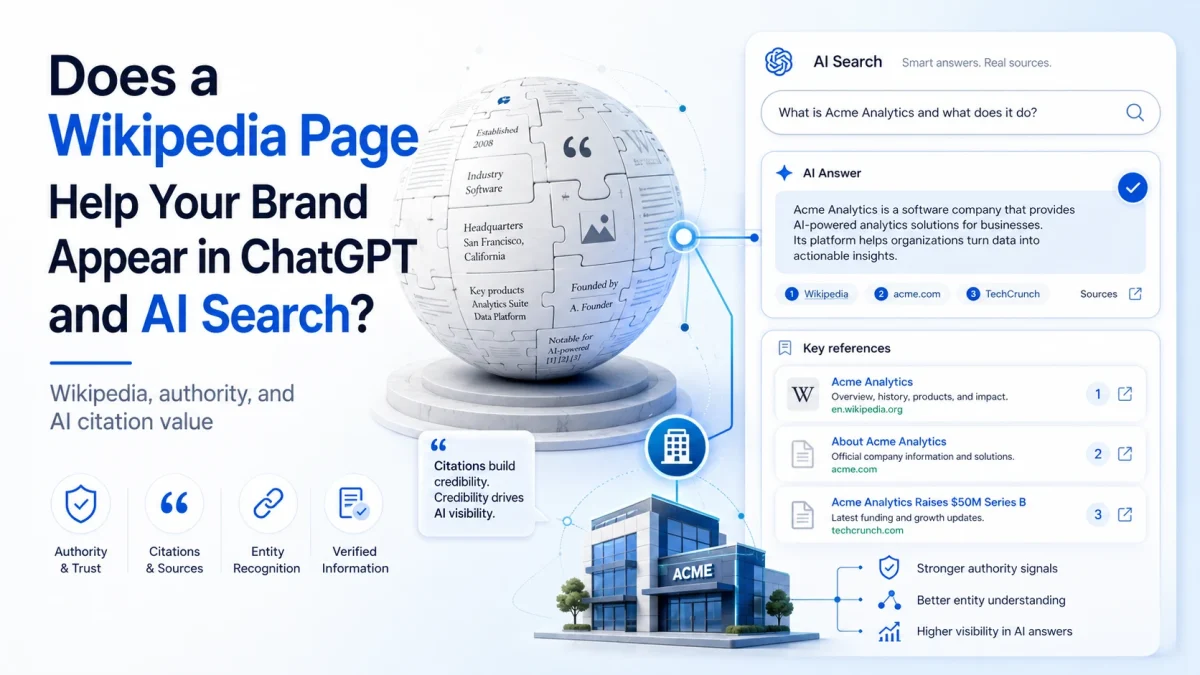
A well-sourced Wikipedia page can improve a company’s visibility in ChatGPT, Perplexity and other AI answer platforms. Its main value is not that it guarantees citations, but that it helps define the company as a recognised entity with a clear history, ownership structure, location and place within an industry.
Wikipedia is most useful when someone asks questions such as:
- Who founded the company?
- Who owns it?
- Where is it based?
- What does it do?
- Which industry does it operate in?
- Is it an established company in its field?
It is much less influential when the question concerns which individual product to buy, what is currently in stock or which item offers the best value.
Key points
A Wikipedia page can strengthen brand and entity visibility in AI-generated answers, but it does not guarantee that a company will be mentioned or cited.
It is most useful for factual, historical, ownership and industry-level questions. It has limited direct value for product recommendations, shopping results, current prices or availability.
A company also needs substantial independent coverage before it is likely to qualify for a Wikipedia article. Press releases, company blog posts and sponsored articles rarely establish notability on their own.
Wikipedia should therefore be treated as one part of a wider Generative Engine Optimization strategy.
Does a Wikipedia page help AI visibility?
It can.
Wikipedia articles are organised around clearly defined subjects. A company page may establish its official name, previous trading names, founders, headquarters, ownership, industry, products, acquisitions and corporate relationships.
This can help search engines and AI systems distinguish one organisation from another.
That is especially useful when a company has a common name, has changed ownership, operates through several brands or is frequently confused with another business.
A well-referenced article can help establish:
- The organisation’s correct name
- Its founding date and history
- Its headquarters and markets
- Its founders and leadership
- Its parent company or subsidiaries
- Its main products and services
- Its industry category
- Significant acquisitions or ownership changes
This supports entity clarity: the ability of a search engine or AI system to identify an organisation and understand how it relates to other people, companies, products and topics.
Why Wikipedia can influence AI answers
A company website describes the business from the company’s own point of view. Wikipedia is designed to summarise what independent sources have reported.
That distinction matters.
When an AI system answers a question such as “Who are the established companies in the garden equipment industry?”, it needs more than promotional statements from manufacturer websites. It needs evidence that helps determine which companies are recognised, what they are known for and where they fit within the market.
Wikipedia can provide part of that context through its connections to independent reporting, company histories, founder biographies, parent companies, acquisitions and related organisations.
However, it should not be treated as an automatic authority signal. Different AI platforms use different sources, and the same platform may produce a different answer when the wording of the query changes.
The value of a Wikipedia page depends on:
- The quality of the article
- The strength of its references
- The type of question being asked
- The availability of newer information
- Whether the query is factual, commercial, local or transactional
Which queries benefit most from Wikipedia?
Wikipedia is strongest when the user is asking about the company itself.
| AI query | Likely value of Wikipedia |
| Who founded the company? | High |
| Where is the company based? | High |
| Who owns the company? | High |
| When was it founded? | High |
| What industry does it operate in? | High |
| What is the company known for? | Medium to high |
| Who are the established companies in this sector? | Medium to high |
| What are the major brands in this category? | Medium |
| What is the best lawnmower under £400? | Low |
| Which product is currently cheapest? | Very low |
| Is this model in stock today? | Very low |
The distinction is straightforward: Wikipedia helps explain the company. It rarely contains the current commercial information needed to recommend a specific product.
Does Wikipedia help product recommendations?
Usually only indirectly.
A recognised brand may be easier for an AI system to identify, but product recommendations depend on current and product-specific information.
For stronger product visibility, companies need:
- Detailed product pages
- Accurate technical specifications
- Consistent model names
- Product structured data
- Merchant feeds
- Retailer listings
- Independent reviews
- Professional testing
- Customer feedback
- Current pricing
- Stock information
- Warranty and delivery details
- Clear use-case information
Wikipedia may strengthen the broader brand entity, but it will not compensate for weak product pages, inconsistent retailer data or a lack of independent reviews.
Does a Wikipedia page guarantee AI citations?
No.
A company may have a Wikipedia page and still be absent from a particular AI answer. Another company without one may be included because it has stronger recent coverage, better product information or more relevant third-party references.
An AI platform may cite Wikipedia directly, prefer the company website, use a recent news article, rely on an industry publication or mention the company without showing Wikipedia as the source.
The real value of Wikipedia is therefore broader than winning one visible citation. It can contribute to the wider body of information that helps AI systems identify and describe the company accurately.
Does having a Wikipedia page make a company notable?
No. A company should normally be notable before an article is created.
Wikipedia is intended to document organisations that have already received meaningful independent coverage. It is not designed to create prominence for businesses that have not attracted substantial editorial attention.
A Wikipedia article is not the same as a company profile or brochure. It must be supported by reliable, independent sources showing that the organisation has received enough attention to justify a standalone entry.
What sources establish Wikipedia notability?
The strongest evidence comes from substantial coverage in reliable, independent secondary sources.
These may include:
- National or established regional newspapers
- Recognised business publications
- Reputable trade and industry magazines
- Books from established publishers
- Major broadcasters
- Independent company profiles
- Investigative reports
- Detailed specialist publications
- Academic or historical works
The depth of coverage matters.
A passing mention in a market roundup does not carry the same weight as a detailed profile, investigation or analysis.
Wikipedia does not set a fixed number of articles, but several strong, independent sources are usually needed. Three to five substantial pieces may be a useful initial benchmark, although quality matters more than quantity.
Three detailed articles from respected publications may be more valuable than 30 short mentions or syndicated press releases.
Do press releases and sponsored articles count?
Press releases may support limited factual details, but they do not usually establish notability because the company controls the content.
Republishing the same release across dozens of websites does not create dozens of independent sources.
The same limitation often applies to:
- Sponsored articles
- Paid interviews
- Advertorials
- Company blog posts
- Executive biographies
- Partner announcements
- Affiliate content
- Corporate case studies
- Social-media posts
These sources may have marketing value, but they do not carry the same weight as independent editorial coverage.
A source is genuinely independent when the company did not control, commission, pay for or substantially shape the article.
What are the risks of creating a page too early?
A weak or premature Wikipedia article may be rejected, deleted or criticised as promotional.
Common problems include:
- Marketing language
- Unsupported leadership claims
- Heavy emphasis on products
- Excessive corporate history
- Dependence on the company website
- Press releases used as the main evidence
- Long lists of minor awards
- Undisclosed paid editing
- Content written like a sales brochure
Words such as “world-leading”, “innovative”, “best-in-class”, “cutting-edge” and “revolutionary” are likely to make an article look promotional.
A failed submission may also become part of the public editorial record. The first step should therefore be an honest notability assessment, not the drafting of the page.
Can a company write its own Wikipedia page?
A company or paid consultant can prepare a draft, but any conflict of interest should be disclosed.
The company does not own the article and cannot guarantee approval, publication, permanent retention, preferred wording or control over future edits.
A more appropriate process is to:
- Disclose the relationship
- Prepare a neutral draft
- Use independent sources
- Avoid marketing language
- Submit the draft for review
- Allow uninvolved editors to assess it
- Accept that it may be changed or rejected
Hiring an outside consultant does not remove the conflict of interest if that consultant is being paid by the company.
Any provider promising a guaranteed or permanent Wikipedia page should be treated with caution.
Is a Wikipedia page worth the effort?
It can be worthwhile when the organisation already has substantial independent coverage and would benefit from stronger entity definition.
The case is stronger when the company:
- Operates in a frequently researched category
- Has a complex corporate history
- Is often confused with another organisation
- Has notable founders or executives
- Has recognised parent companies or subsidiaries
- Has completed significant acquisitions
- Operates internationally
- Needs clearer public information about ownership
It is less likely to be worthwhile when independent coverage is weak, most sources are press releases, the goal is immediate lead generation or the objective is product-level shopping visibility.
The backlink is not the main benefit. The greater value lies in entity definition, independent corroboration and clearer relationships between the company and other recognised subjects.
What should a company do if it does not yet qualify?
A company that lacks sufficient coverage should build genuine authority rather than trying to force a Wikipedia article.
Useful priorities include:
Publish original research
Create market data, industry surveys, benchmark reports, technical research or expert analysis that journalists and industry publications may cite.
Earn independent media coverage
Give reputable publications a genuine editorial reason to discuss the company through original findings, major developments, acquisitions, regulatory insight or meaningful market analysis.
Improve entity consistency
Make sure the company name, address, ownership, leadership, industry category, founding date and product descriptions are consistent across the official website and reputable third-party sources.
Strengthen the official website
Create factual pages covering company background, leadership, history, ownership, locations, products, research and press contacts.
Test current AI visibility
Monitor how major AI platforms describe the company, its ownership, competitors, products, founders and industry position. Incorrect answers often reveal wider gaps in the available information.
Wikipedia should be part of a wider GEO strategy
Wikipedia works best when it supports a broader network of accurate, well-sourced and consistent information.
AI platforms may draw from official websites, news publications, government records, academic research, industry publications, retailers, reviews, forums, directories and structured data.
Generative Engine Optimization is not about manipulating a single source. The goal is to make an organisation easy to identify, easy to understand and well supported by credible evidence.
Wikipedia can contribute to that goal, but it should not be treated as the entire strategy.
Frequently asked questions
Does Wikipedia guarantee that ChatGPT will mention a company?
No. It may improve entity recognition and provide useful factual information, but it does not guarantee a mention or citation.
Does a Wikipedia page improve product recommendations?
Usually not directly. Product recommendations depend more heavily on specifications, prices, reviews, availability and independent comparisons.
How many sources are needed for a company Wikipedia page?
There is no fixed number. Several substantial, reliable and independent sources are normally required.
Do press releases establish Wikipedia notability?
Generally not. They originate with the company and do not demonstrate independent editorial recognition.
Can a company pay someone to create its page?
Yes, but the paid relationship and conflict of interest should be disclosed. Payment does not guarantee acceptance or retention.
Is a Wikipedia page useful for GEO?
Yes, particularly for entity recognition, company history, ownership questions, factual queries and industry-level answers. It is less useful for shopping and transactional queries.
Final assessment
A legitimate Wikipedia page can improve brand-level AI visibility by helping search engines and AI platforms identify and understand an organisation.
It is most useful for company information, ownership, founders, corporate history, industry categories and market overviews. It is far less useful for product rankings, current prices, stock availability and shopping recommendations.
A Wikipedia article should be the result of established notability, not an attempt to manufacture it.
The right question is not:
How can we get a Wikipedia page?
It is:
Has the company already received enough substantial, independent and reliable coverage to justify one?
When the answer is yes, a carefully sourced and neutrally written article may strengthen the company’s visibility across AI search.
When the answer is no, the better investment is to build genuine authority, earn independent coverage and make the company’s information more consistent across the web.
Methodology
This article draws on Wikipedia’s published guidance on organisational notability, reliable sourcing, conflicts of interest and paid contributions, together with practical GEO analysis of brand, company, category and product-level queries across major AI answer platforms.
Author: Simon Royle
Specialism: Generative Engine Optimization, AI-search visibility, entity authority and supporting SEO strategy