
By Simon Royle
Published: 19th June 2026
Last updated: 19th June 2026
Search terminology is becoming increasingly confusing.
The acronym GEO is now being used in two very different ways.
In traditional digital marketing, “geo” usually refers to geographic targeting, location-based advertising, local search, or dividing customers by location.
In the newer world of generative search, GEO means Generative Engine Optimization: the work involved in improving how a business, brand, product, expert, or website appears in generated answers.
Add AEO, meaning Answer Engine Optimization, and SEO, meaning Search Engine Optimization, and it is easy to see why business owners and marketers are struggling to understand what each term means.
This is not simply an argument over acronyms.
The confusion reflects a much larger change in how people search, how platforms provide information, and how businesses need to think about online visibility.
The Short Explanation
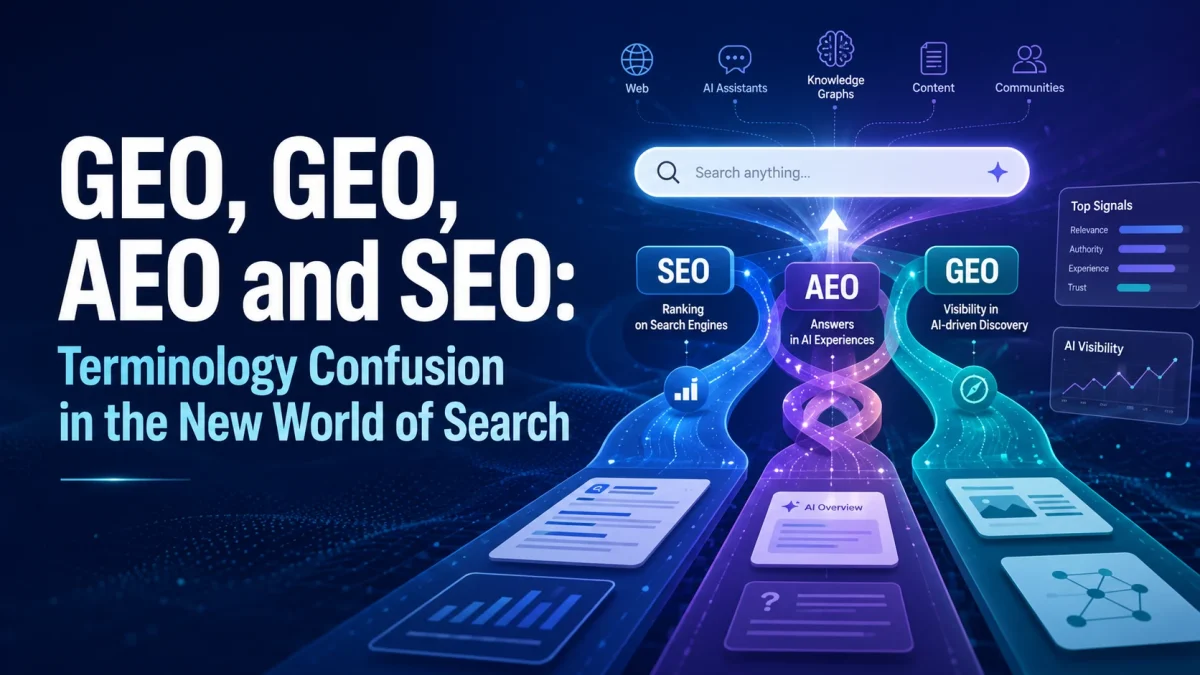
GEO can mean either geographic targeting or Generative Engine Optimization. AEO means Answer Engine Optimization, while SEO means Search Engine Optimization. SEO focuses on search visibility and rankings, AEO focuses on providing clear direct answers, and generative GEO focuses on being mentioned, represented, or cited within generated responses.
The four terms are related, but they do not mean the same thing.
| Term | Meaning | Main purpose |
|---|---|---|
| SEO | Search Engine Optimization | Improve search visibility, rankings, traffic, and conversions |
| AEO | Answer Engine Optimization | Make content easy to use in direct answers |
| GEO | Generative Engine Optimization | Improve visibility, mentions, and citations in generated responses |
| Geo-targeting | Geographic targeting | Reach or serve users according to their location |
GEO Can Mean Two Different Things
Before discussing the future of search, it is important to separate the two common meanings of GEO.
GEO as Geographic Targeting
For many years, marketers have used “geo” to describe geographic targeting.
This includes:
- targeting advertising by country, state, region, city, or postcode
- showing different offers to people in different locations
- adjusting campaigns for local markets
- directing customers to the nearest branch or store
- using location information to improve advertising relevance
- creating location-specific landing pages
- supporting local SEO campaigns
A business running different campaigns in London, New York, and Sydney may describe this as geo-targeting.
A retailer displaying different products, delivery options, or prices according to a visitor’s location may also use geographic targeting.
This version of GEO is about where the customer is located.
GEO as Generative Engine Optimization
GEO is now also used to mean Generative Engine Optimization.
This refers to work intended to improve the likelihood that a company, product, service, expert, or website will appear in generated answers, summaries, recommendations, comparisons, and citations.
This newer meaning of GEO is concerned with questions such as:
- Is the company mentioned in generated answers?
- Is its website cited as a source?
- Is the brand described accurately?
- Is the business included in recommendations or comparisons?
- Do generative systems understand what the company does?
- Is the company recognised as an authority in its field?
- Are its products correctly connected to the problems they solve?
- Does the company appear when users ask category-level questions?
These are completely different uses of the same term.
One relates to location.
The other relates to visibility within generative search.
Search Used to Be Easier to Explain
The traditional search model was relatively simple.
A person typed a question or a few keywords into Google.
Google returned a page of links.
Businesses used SEO to improve their chances of appearing near the top of those results.
That model has not disappeared, but it is no longer the whole story.
People are now asking questions in ChatGPT, Gemini, Perplexity, Microsoft Copilot, Google AI Overviews, Google AI Mode, and other answer-based systems.
Instead of receiving only a list of links, users may receive:
- a complete summary
- a product recommendation
- a shortlist of companies
- a comparison
- a step-by-step explanation
- a direct answer supported by selected sources
This change has produced a growing collection of terms:
- SEO
- AEO
- GEO
- AI search optimization
- AI SEO
- LLM optimization
- generative search optimization
- search experience optimization
The terminology is becoming crowded and, in some cases, unnecessarily complicated.
The important issue is not which acronym eventually wins.
The important issue is understanding how search has changed and what businesses now need to do to remain visible.
What Is SEO?
SEO stands for Search Engine Optimization.
SEO is the work involved in improving a website’s visibility in search engines.
This includes making sure that a website can be crawled, indexed, understood, and presented correctly.
Traditional SEO work may include:
- technical website improvements
- keyword research
- page titles and meta descriptions
- content creation
- internal linking
- external authority and backlinks
- structured data
- page speed
- mobile usability
- local search optimization
- conversion tracking
- measurement through Google Search Console and analytics platforms
SEO remains the foundation of online search visibility.
A website still needs to be technically sound, clearly structured, accurate, useful, and accessible.
Pages still need sensible titles, logical headings, relevant internal links, clear subject matter, and content that answers genuine questions.
Generative search has not removed the need for SEO.
In many cases, generative systems depend on information discovered through websites, search indexes, product feeds, business profiles, databases, and trusted external sources.
A page that cannot be found, crawled, understood, or trusted is unlikely to perform well in either traditional search or generative search.
This is why claims that “SEO is dead” are misleading. (Note: We use the phrase, “SEO is dead”, merely to emphasize the massive shift that is happening, because it seems to us business is moving too slowly to adapt).
SEO is not dead.
It is expanding.
What Is AEO?
AEO stands for Answer Engine Optimization.
AEO focuses on making content easy to find, understand, and use when providing a direct answer.
The term became associated with:
- featured snippets
- People Also Ask results
- voice search
- digital assistants
- knowledge panels
- question-and-answer results
- systems designed to provide an answer rather than only a list of links
AEO often involves:
- answering the main question clearly
- using logical headings
- providing short definitions
- including useful FAQs
- using tables and lists where appropriate
- writing in plain language
- making the connection between a question and its answer obvious
- supporting the short answer with fuller explanation and evidence
For example, a page targeting the question “What is DMARC?” should not make the reader work through 1,500 words before reaching a definition.
It should provide a clear answer near the beginning and then expand on that answer with examples, supporting information, and practical guidance.
AEO is not separate from good content writing.
It is a way of structuring useful information so that both people and answer systems can understand it quickly.
What Is Generative Engine Optimization?
Generative Engine Optimization describes work intended to improve the visibility of a business, brand, product, expert, or website within generated answers.
The term was formalised in the 2023 research paper GEO: Generative Engine Optimization.
Traditional search generally ranks pages.
Generative search may retrieve information from several sources, combine that information, summarise it, and produce a new response.
This changes the objective.
The goal is no longer only to rank a page.
The goal may also be to have information from that page:
- selected
- included
- summarised
- attributed
- cited
- used in a comparison
- used to support a recommendation
Generative systems need to understand more than individual keywords.
They need to understand:
- who the business is
- what the business does
- which subjects it has authority in
- which products or services it provides
- who its products or services are intended for
- how those products compare with alternatives
- whether its claims are supported
- whether other credible sources confirm its authority
- whether its information is current
- whether information about the business is consistent across the web
GEO therefore includes content structure, but it also includes authority, evidence, reputation, external mentions, entity clarity, source quality, and consistency.
How SEO, AEO, and GEO Work Together
SEO, AEO, and GEO should not be treated as three completely separate activities.
They overlap.
SEO helps a page become discoverable and understandable.
AEO helps the page provide a clear direct answer.
GEO considers whether the business and its information are selected, represented, mentioned, or cited within a generated response.
Consider a cybersecurity company that sells email security software.
SEO example
The company creates a strong page targeting:
Business email security software
The page is technically accessible, properly linked, relevant to the search, and supported by other useful content.
The SEO objective is to improve rankings, impressions, traffic, and conversions.
AEO example
The company publishes a clear answer to:
What does DMARC protect against?
A short definition appears near the top, followed by a detailed explanation, examples, and supporting evidence.
The AEO objective is to make the page suitable for direct-answer results.
GEO example
A user asks a generative search system:
Which email security companies provide DMARC protection for small businesses?
The GEO objective is for the company to be included accurately in the answer, recognised as relevant, and ideally cited as a source.
The same website may support all three outcomes.
The difference lies partly in the question being asked and partly in what the business is measuring.
Is GEO Really Different from SEO?
This is where much of the terminology confusion begins.
Google’s position is that the established principles of SEO continue to apply to its generative search features.
That is reasonable.
Good SEO supports GEO because generative systems need accessible, relevant, reliable, and understandable information.
Technical SEO still matters.
Content quality still matters.
Internal links still matter.
Authority still matters.
Trust still matters.
However, the outcome being measured is not always identical.
SEO traditionally focuses on:
- rankings
- impressions
- clicks
- organic traffic
- click-through rate
- search conversions
- indexed pages
- keyword visibility
GEO adds measurements such as:
- mentions in generated answers
- citations in generated answers
- accuracy of brand descriptions
- inclusion in recommendations
- inclusion in category comparisons
- visibility across several generative platforms
- competitor share of voice
- the sources selected to support an answer
- the questions for which a company is recognised
The work overlaps, but the reporting may be different.
A page may rank well in Google and still be absent from ChatGPT or Perplexity answers.
A company may also be mentioned frequently in generated answers without receiving a click every time.
That does not mean the visibility has no value.
A user may:
- become familiar with the company
- include it in a shortlist
- search for it directly later
- ask a follow-up question about the brand
- visit the website during a later stage of the buying process
The route from discovery to conversion is changing.
Google’s View of GEO and AEO
Google now acknowledges that AEO and GEO are terms used to describe work focused on visibility in generative search experiences.
However, Google’s position is that optimizing for generative features in Google Search is still part of SEO.
Its guidance emphasises established fundamentals:
- meeting technical search requirements
- making pages crawlable and indexable
- producing useful and original content
- ensuring important information is available as text
- using clear internal links
- supporting structured data with visible page content
- keeping business and product information accurate
- providing genuine value rather than relying on tricks
Google also states that special files or new markup are not required to appear in its generative search results.
There is no single technical switch that makes a website visible in generated answers.
This is an important point.
GEO should not be sold as a collection of secret hacks.
It is a developing area of search work built on discoverability, clarity, authority, evidence, and measurement.
Why the Terminology Matters Less Than the Work
Businesses should not become trapped in arguments over acronyms.
Whether a company calls the work SEO, GEO, AEO, AI SEO, or search visibility, the practical questions remain the same:
- Can search systems find the content?
- Can they understand what the business does?
- Does the website answer the questions customers are asking?
- Is the information clear enough to quote or summarise?
- Are important claims supported?
- Is the business recognised as an authority beyond its own website?
- Is information about the company consistent across the web?
- Does the content provide something more useful than generic material already available elsewhere?
- Is the business included in relevant recommendations and comparisons?
- Is the company being described accurately?
These questions cannot be answered by adding a few keywords to a page.
They require a broader review of the company’s:
- website
- content
- technical structure
- authority
- reputation
- third-party mentions
- expert credentials
- product information
- search visibility
- generative search visibility
The New Search Journey
The modern search journey is no longer linear.
A potential customer may:
- ask ChatGPT for a shortlist
- check a product in Google
- read a Reddit discussion
- visit the company website
- return to Perplexity for a comparison
- watch a YouTube video
- search for customer reviews
- ask Gemini a final question before buying
The company needs to remain visible and consistent throughout that journey.
Website content cannot exist in isolation.
Product pages, articles, case studies, expert biographies, original research, press coverage, customer reviews, third-party mentions, structured data, and technical SEO all contribute to how a business is understood.
The strongest businesses in generative search will not simply be those publishing the largest volume of content.
They will be the businesses providing the clearest, most useful, best-supported, and most consistently recognised information.
What Makes Content Easier to Use in Generated Answers?
There is no guaranteed formula for being cited or mentioned.
However, content is generally more useful when it includes:
- a clear answer near the beginning
- a logical heading structure
- specific rather than vague claims
- original examples
- clear definitions
- comparison tables
- supporting evidence
- named authors
- visible publication and update dates
- accurate company information
- relevant internal links
- links to credible supporting sources
- content that adds something beyond common knowledge
The objective should not be to write for machines instead of people.
The objective should be to publish content that is easy for people to understand and easy for search systems to interpret correctly.
Authority Is More Than What a Company Says About Itself
A business cannot establish authority only by repeatedly describing itself as an authority.
Search engines and generative systems may also consider information found outside the company’s own website.
This may include:
- independent press coverage
- industry publications
- research citations
- professional associations
- expert biographies
- conference appearances
- reliable directories
- customer discussions
- product reviews
- academic or technical references
- recognised partnerships
The aim should not be to manufacture mentions.
The aim should be to create work, research, products, expertise, and useful information that other credible sources have a reason to discuss.
This is sometimes referred to as building a source of trust.
Measuring GEO
GEO measurement is still developing.
There is no universal equivalent of a traditional ranking report.
A practical GEO report may track:
- whether the company is mentioned
- whether the company website is cited
- which page is cited
- whether the description is accurate
- which competitors are included
- which sources are used
- how results vary between platforms
- how results change over time
- which prompts trigger the company
- which prompts should trigger the company but do not
Testing should be repeated over time because generated responses may vary.
A single query on a single platform is not enough to establish a trend.
The value comes from using a consistent group of relevant questions and recording the results regularly.
What Businesses Should Do Now
Businesses do not need to abandon SEO and start again.
They do need to widen the scope of their search work.
A practical approach should include:
- maintaining strong technical SEO
- reviewing whether important pages answer questions clearly
- building content around genuine customer needs
- improving internal links and site structure
- strengthening author and company authority
- supporting claims with reliable evidence
- checking how the company appears across generative platforms
- measuring mentions and citations alongside rankings and traffic
- correcting unclear or inconsistent information
- producing original material that competitors cannot easily copy
- monitoring how products, services, and experts are described
- comparing company visibility with competitors
- updating older content rather than simply publishing more pages
The biggest mistake is assuming that generative search can be addressed with a few formatting tricks.
There is no single piece of markup, special file, keyword formula, or article structure that guarantees inclusion in a generated answer.
Visibility comes from a combination of:
- accessibility
- relevance
- clarity
- authority
- trust
- evidence
- originality
- consistency
Frequently Asked Questions
What does GEO mean in marketing?
GEO can refer to geographic targeting, which uses a customer’s location to shape advertising, content, offers, or local campaigns. More recently, GEO has also come to mean Generative Engine Optimization, which focuses on improving visibility within generated search responses.
Why does GEO have two meanings?
The abbreviation developed in two different areas of digital marketing. “Geo” has long been shorthand for geographic or location-based targeting. Generative Engine Optimization later adopted the same letters to describe optimization for generative search systems.
What is the difference between SEO, AEO, and GEO?
SEO improves visibility in search engines. AEO structures content so that it can provide clear direct answers. GEO focuses on whether a company, brand, product, or source appears within generated answers, recommendations, summaries, and citations.
Is GEO replacing SEO?
No. GEO builds on many of the same foundations as SEO. A website still needs to be crawlable, indexable, understandable, useful, and authoritative. GEO widens the measurement of visibility beyond rankings and clicks.
Is AEO part of SEO?
AEO can reasonably be treated as part of SEO. It focuses specifically on making content suitable for direct answers, featured snippets, voice responses, question results, and other answer-led search experiences.
Does geo-targeting have anything to do with Generative Engine Optimization?
Not directly. Geo-targeting concerns the physical location of the audience. Generative Engine Optimization concerns visibility within generated responses. They share the same abbreviation but address different objectives.
How is GEO measured?
GEO can be measured by tracking brand mentions, citations, source selection, description accuracy, competitor visibility, recommendation inclusion, and performance across a consistent set of prompts and platforms.
Does structured data guarantee GEO visibility?
No. Structured data can help search systems understand certain page information, but it does not guarantee rankings, rich results, mentions, or citations in generated answers.
Do businesses need a special file for generative search?
There is no single special file that guarantees inclusion in generative search results. For Google Search, established SEO practices, technical accessibility, useful content, and accurate business information remain the main foundations.
Is SEO still relevant in generative search?
Yes. Generative search still depends on discoverable, understandable, reliable information. Technical SEO, useful content, internal linking, authority, and clear site structure remain important.
SEO, AEO, and GEO Are Part of the Same Search Environment
SEO helps search engines find, understand, and rank content.
AEO helps answer systems identify and present clear responses.
Generative GEO focuses on whether a business or its information appears within generated answers.
Geographic GEO remains concerned with location and audience targeting.
These are different disciplines, but they now exist within the same wider search and digital marketing environment.
The practical conclusion is simple.
Businesses still need SEO, but search visibility can no longer be measured only through rankings and clicks.
Businesses also need to understand:
- how they are represented
- whether they are cited
- whether answer platforms recognise them as a credible source
- whether their products and services are described accurately
- whether competitors are being recommended instead
- whether their authority is visible beyond their own website
The terminology will continue to change.
The need to be visible, understandable, authoritative, and trusted will not.
Sources and Further Reading
- Google Search Central: Optimizing for Generative AI Features in Google Search
- Google Search Central: AI Features and Your Website
- Google Search Central: SEO Starter Guide
- Google Search Central: Creating Helpful, Reliable, People-First Content
- Google Search Central: Introduction to Structured Data
- Aggarwal et al.: GEO — Generative Engine Optimization
About The Author

Simon Royle is a Generative Engine Optimisation (GEO) specialist, technology strategist, and Chief Architect of GeoAnalyzer Pro. Drawing on decades of experience across technology, digital marketing, and business development, he helps organisations improve how their brands and content are discovered, understood, trusted, and cited by AI-powered platforms such as ChatGPT, Google AI Overviews, Gemini, Claude, and Perplexity. His work combines GEO auditing, AI-search visibility analysis, content strategy, technical optimisation, and practical recommendations designed to prepare businesses for the rapidly evolving future of online search.