
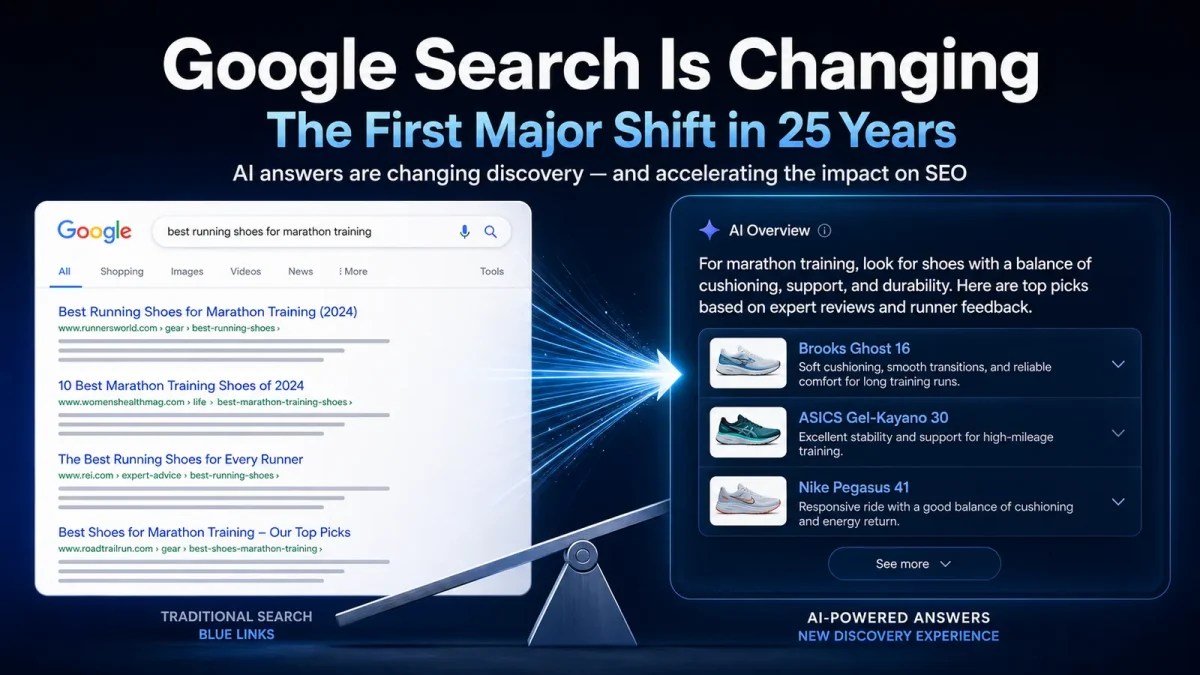
TechCrunch’s article, “Google Search as you know it is over,” makes the core issue plain: the old search model of ranked blue links is being replaced by AI-generated answers, conversational search, interactive search experiences, and agent-driven information gathering. Google is no longer just sending users to websites. Increasingly, it is interpreting the web on the user’s behalf.
For businesses, that changes the visibility game completely. The fulcrum on the SEO/GEO levers has shifted, dramatically.
Traditional SEO was built around the idea that a user typed a keyword, scanned a results page, clicked a link, and visited a website. But TechCrunch reports that Google’s new AI-powered search box will support longer, more conversational queries, AI-generated query suggestions, follow-up questions in AI Mode, and “information agents” that work in the background to track and synthesize information.
That means discovery is moving from search results to AI-selected answers.
This is exactly the problem GeoAnalyzer Pro, or GAP, is designed to solve.
GAP starts from a simple premise: if AI systems such as Google AI Overviews, Gemini, ChatGPT, Claude, and Perplexity are now shaping what people see, then brands need to understand whether they are being cited, understood, and recommended by those systems. The GeoAnalyzer Pro website puts it directly: if your brand is not being surfaced by AI systems, you are slowly disappearing.
The biggest challenge is that AI engines do not read websites the same way humans do. A human can skim a homepage, infer context, and understand branding. An AI retrieval system needs clean, structured, unambiguous information. GAP addresses this through baseline visibility audits, technical infrastructure checks, competitive mapping, and actionable optimization tasks designed for AI-driven search.
One of the most important GAP concepts is the GEO Score. Instead of asking only where a page ranks in Google, GAP asks a more relevant question: why would an AI system cite this brand, or fail to cite it? That matters because in the new search experience, the winning brand may not be the one ranked first in the traditional organic results. It may be the brand whose content is easiest for an AI model to retrieve, verify, summarize, and trust.
GAP also helps identify the Visibility Gap: the lost opportunity when an AI system cites a competitor instead of your brand. In the old SEO world, this might have meant losing a click. In the AI-search world, it can mean being absent from the answer altogether. If the user never reaches the list of links, the brand that is included inside the AI response has a significant advantage.
Another major issue raised by the TechCrunch article is the rise of AI agents. These agents will not browse like people. They will monitor, extract, compare, and synthesize. GAP prepares brands for that environment by improving crawl visibility, structured data, entity clarity, and content organisation. Its glossary defines GEO as the practice of influencing how large language models synthesize and cite a brand, with the goal of making the domain a primary grounding source in AI-generated summaries.
GAP’s Semantic Retrieval Blocks are especially relevant here. The platform focuses on turning messy web content into granular, RAG-ready units of information that AI systems can ingest and cite more reliably. This reduces ambiguity, improves fact density, and lowers hallucination risk. In practical terms, it helps a business become a cleaner source of truth for AI systems.
The key lesson from TechCrunch’s article is not that SEO disappears overnight. It is that SEO is no longer enough. Businesses now need to optimize for answer engines, AI Overviews, retrieval systems, and automated agents.
That is where GAP fits.
GeoAnalyzer Pro gives brands a way to measure their current AI visibility, understand why competitors may be winning citations, improve the structure of their digital assets, and build the trust signals AI systems need before they include a brand in an answer.
Google Search is becoming less about links and more about answers.
GAP helps make sure your brand is one of those answers. SEO is dead. Long Live GEO.