
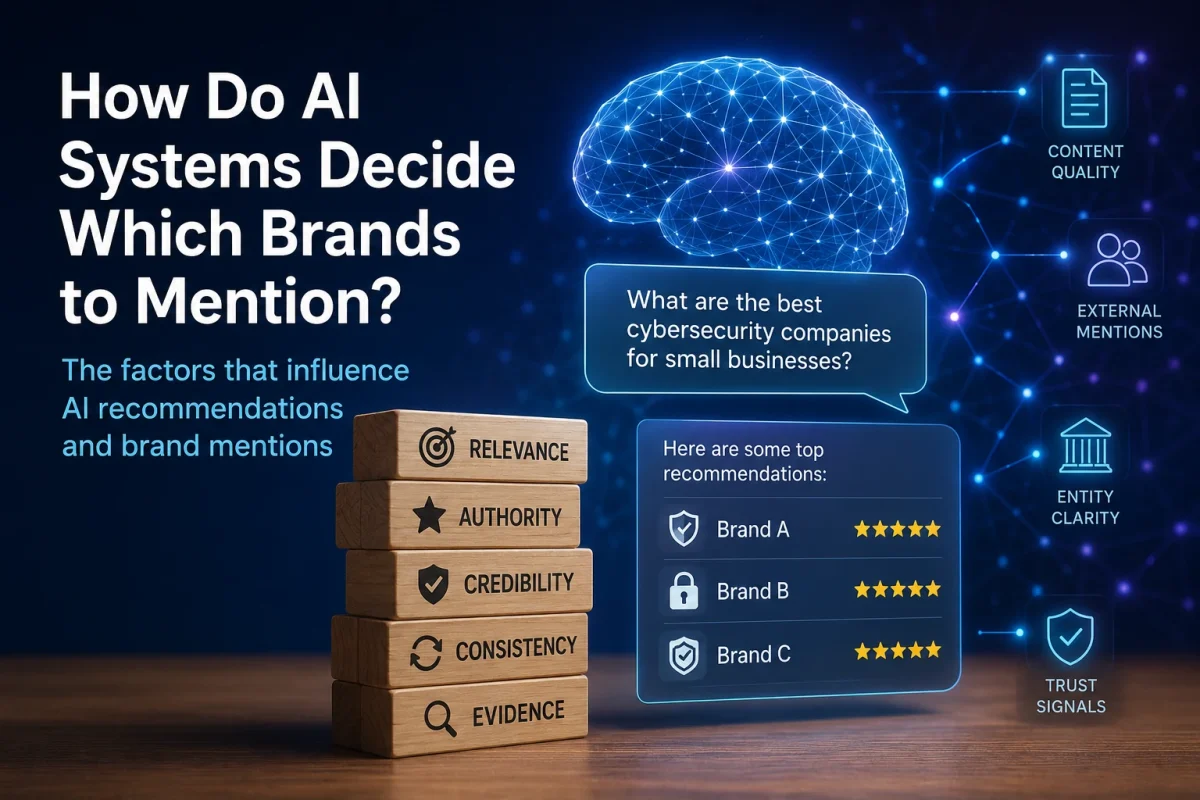
Which Brands Get Mention?
One of the most important questions in Generative Engine Optimization is also one of the least understood.
Why does an AI system mention one company and ignore another?
Two businesses can offer almost identical services, operate in the same market and have websites covering many of the same subjects. Yet ask ChatGPT, Gemini or Perplexity for recommendations and one may appear regularly while the other is rarely mentioned.
There is no single answer to this, and there is certainly no magic setting that makes a company appear in AI-generated responses.
What matters is the body of evidence an AI system can find and understand about the business.
That distinction is important.
You are not simply trying to persuade an AI system that your website deserves to rank. You are trying to make your business sufficiently clear, credible and relevant that it can reasonably be included in an answer.
AI systems need to know what your business is
Before an AI system can recommend or mention a company, it has to understand what that company actually does.
This sounds straightforward, but many websites make it surprisingly difficult.
A business might describe itself as delivering “innovative solutions”, “transformational services” or “industry-leading expertise” without clearly stating the services it provides, who they are for or where it operates.
A human visitor can sometimes work it out by reading several pages.
An AI system should not have to.
If you are a cybersecurity company serving small and midsized businesses in the UK, say so.
If you are an executive search firm specialising in life sciences, make that relationship clear throughout the site.
If you provide specialist medical treatment in Washington DC, the website needs to establish the service, expertise and location clearly.
The easier it is to understand the business, the easier it becomes to associate that business with the questions potential customers are asking.
Relevance comes before reputation
Being well known is useful, but it is not the same thing as being relevant.
An AI system answering a specific question needs sources and businesses that fit that question.
If someone asks for the best accounting software for a small construction company, being a large software company is not enough. The system needs evidence connecting a particular product with accounting, small businesses and ideally the construction sector.
The same applies to services.
A company cannot assume that because it has a strong brand, AI systems will automatically understand every market or specialist area in which it operates.
This is why topical coverage matters.
If a business wants to be associated with a particular subject, there needs to be enough clear information supporting that association.
One page is often not enough.
The website as a whole should make the relationship obvious.
Your website is only part of the evidence
This is where GEO begins to differ from the way many businesses think about conventional website optimisation.
You control what your own website says about you.
An AI system can also find what everyone else says about you.
Those external references can be extremely important.
A company that describes itself as a leading specialist in a particular field is making a claim.
If industry publications, professional organisations, customers, partners, directories and other credible sources repeatedly associate that company with the same field, the claim has considerably more support.
This does not mean chasing mentions simply for the sake of collecting them.
It means building a consistent picture of the business across the web.
If your website says one thing, LinkedIn says another, directory listings are outdated and third-party references barely mention your main area of expertise, the picture becomes less clear.
Consistency matters because AI systems are trying to understand relationships between entities, subjects and sources.
Specific evidence is stronger than general claims
Businesses are often far too vague about their expertise.
“Trusted by businesses worldwide” tells us very little.
“Implemented cybersecurity monitoring for 120 UK manufacturing businesses” tells us considerably more.
The same applies to case studies, research, customer results, professional experience and original data.
Specific information gives an AI system something concrete to work with.
This is one of the reasons original material can be particularly valuable for GEO.
If your company publishes research, benchmarks, useful statistics or genuinely informed analysis that is not simply repeating what is already available elsewhere, you are giving both people and AI systems a reason to pay attention.
Original information can also attract references from other sources, which strengthens the wider body of evidence around the company.
Authority is usually cumulative
There is a tendency to think there must be one dominant signal behind an AI mention.
In practice, it is more useful to think about accumulation.
Does the company clearly describe what it does?
Does it have useful content covering the subject?
Are the people behind the content identifiable?
Is there evidence of experience?
Are other credible websites mentioning the company?
Are its products or services discussed elsewhere?
Are descriptions of the company reasonably consistent across different sources?
Does the website contain information that actually answers the kind of question being asked?
Each individual signal may be relatively modest.
Taken together, they can create a strong and understandable picture of the business.
That is far more valuable than trying to optimise one page around a phrase and hoping an AI engine notices it.
Recognition matters
Another important factor is whether the business exists clearly as an identifiable entity beyond its own website.
A company name appearing consistently across its website, LinkedIn, industry profiles, partner sites, directories and press coverage gives search and AI systems more opportunities to understand that the references relate to the same organisation.
The same applies to people.
If an author, consultant, doctor, executive or specialist is clearly identified and their expertise can be corroborated elsewhere, that can strengthen the relationship between the person, the organisation and the subject.
This is not particularly new.
Search engines have been developing entity understanding for years.
What has changed is the importance of that understanding when an AI system is constructing an answer rather than simply producing ten blue links.
AI systems also need usable information
You can have expertise and authority and still make life unnecessarily difficult for an AI system.
Important information buried inside vague copy, image-based text, badly structured pages or unnecessarily complicated language is harder to use.
The strongest pages tend to answer questions clearly.
They define things.
They explain relationships.
They use descriptive headings.
They identify companies, people, products and services properly.
They provide enough context for a passage to make sense when considered on its own.
This does not mean writing for machines.
In fact, much of the best GEO work improves the content for human readers at exactly the same time.
Clear writing is clear writing.
Being mentioned is not guaranteed
It is worth stating this because there is already too much certainty being sold around GEO.
No agency, consultant or software platform can guarantee that ChatGPT, Gemini, Perplexity or another AI system will mention a particular business for a particular question.
The systems change.
Their available sources change.
Different prompts produce different answers.
Personalisation, location and other context can also influence what is returned.
The objective is not to manufacture a guaranteed mention.
The objective is to improve the evidence available to the systems making the decision.
That is something a business can work on.
Ask a simple question
If you want to know whether your business is in a strong position, start with this:
If an AI system had never heard of us before, could it work out from the available evidence exactly what we do, what we know, who we serve and why we are credible?
Then go one step further.
Could it find independent evidence supporting that picture?
If the answer to either question is no, there is work to do.
Generative Engine Optimization is partly about making good information easier for AI systems to find and use.
But when it comes to brand mentions, it is also about building a sufficiently strong and consistent body of evidence that mentioning your company makes sense in the first place.
About the Author

Simon Royle is an author and Generative Engine Optimization specialist focused on helping businesses improve their visibility in AI-powered search.
He works across GEO strategy and implementation, including website analysis, content, entity clarity, structured data, AI citations and measurement. He is also the author of The GEO Success Series, which explores practical ways businesses can prepare their websites and digital presence for AI search.
Simon is the creator of GEOAnalyzer Pro, a platform developed to assess how well websites are positioned for visibility across AI search and answer engines.