
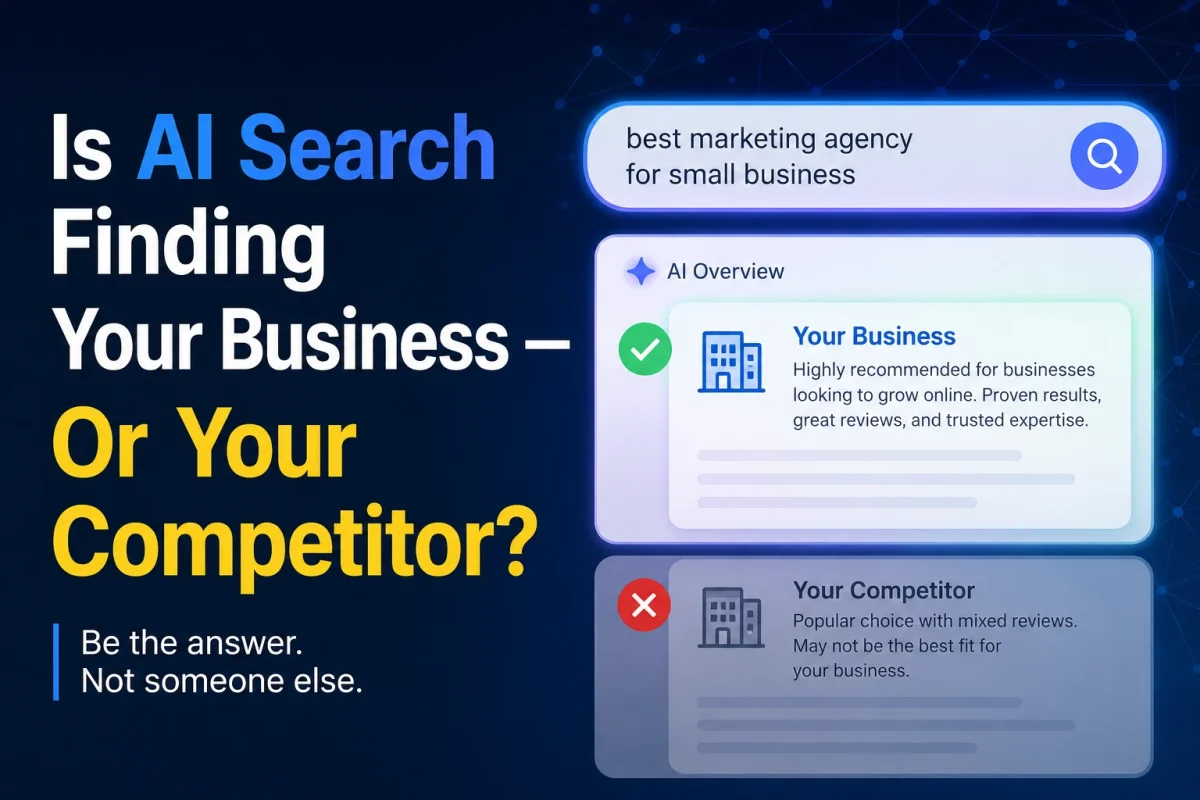
A practical guide to measuring whether ChatGPT, Gemini, Google AI Overviews, Claude and Perplexity understand, cite and recommend your brand.
For years, digital visibility was mostly judged through traditional search. If your business ranked well on Google, attracted organic traffic, and converted that traffic into enquiries or sales, you had a reasonable view of whether your website was doing its job.
That world has not disappeared. Google rankings, organic traffic, technical SEO, useful content, page speed, backlinks, and conversion tracking still matter.
But they are no longer the whole picture.
A growing number of prospective customers are now using AI-powered answer engines as part of their decision-making process. They ask ChatGPT for recommendations. They use Gemini or Google AI Overviews to summarize choices. They ask Perplexity for cited answers. They use Claude to compare options, understand unfamiliar markets, or shortlist suppliers.
The question is no longer only:
“Does my website rank in Google?”
The new question is:
“When AI systems answer questions about my market, do they find, understand, cite, and recommend my business — or do they recommend my competitor?”
That is the visibility gap many businesses have not yet measured.
The shift from search results to AI answers
Traditional search usually gives users a list of links. AI search gives users an answer.
That difference matters.
In a classic search journey, a prospective customer might type a query into Google, scan the results page, open several websites, compare businesses, and make a decision.
In an AI-led journey, the customer may ask:
“Who are the best providers of X near me?”
“What should I look for when choosing a company that does Y?”
“Compare Company A and Company B.”
“What are the most trusted providers for this service?”
“What questions should I ask before hiring a supplier?”
“What are the best options for a small business with my budget?”
The AI system may then summarize the market, name several brands, explain strengths and weaknesses, and cite selected sources. In some cases, the user may never visit ten websites. They may start with the AI answer and only click through to the businesses that appear credible, relevant, and trusted inside that answer.
That means visibility is moving upstream.
Your website still matters, but it is not only trying to persuade human visitors. It also needs to be clear, structured, authoritative, and trustworthy enough for AI systems to interpret it correctly.
The uncomfortable question: who is being recommended?
Most businesses do not know how they appear inside AI-generated answers.
They may know their Google rankings. They may know their organic traffic. They may know which pages receive leads. But they often do not know whether ChatGPT, Gemini, Google AI Overviews, Claude, or Perplexity can answer basic questions about their business.
For example:
Can AI accurately describe what your business does?
Does it understand your services, products, locations, specialisms, and audience?
Does it cite your website, or does it cite third-party directories, competitors, outdated pages, or generic articles?
When asked for recommendations, does it include you?
When asked to compare options, does it know why you are different?
When asked about your category, does it surface your competitors first?
When asked for trusted sources, does your brand appear at all?
If the answer is “we don’t know,” then you have a measurement problem.
And if your competitor is appearing in those answers while you are absent, you have a commercial problem.
Why traditional SEO data is not enough
Google Search Console, Analytics, rank tracking, and SEO tools are still important. But they were not designed to fully measure AI visibility.
Traditional SEO data can tell you whether people are finding your website through Google. It can show clicks, impressions, queries, landing pages, and rankings. That is useful.
But AI discovery can happen before a click.
A user may ask an AI tool for a shortlist. The AI may name three businesses. If your competitor appears and you do not, the customer may never search for you directly. You may not see a lost impression. You may not see a lost visit. You may simply never enter the customer’s consideration set.
That is why AI visibility needs its own measurement layer.
You need to know whether your brand appears in answer engines, how it is described, whether it is cited, what sources support the answer, and which competitors are being used as alternatives.
What does it mean for AI to “understand” your brand?
AI systems do not understand brands in the human sense. They work from patterns, content, retrieval, citations, training data, search results, structured information, and the sources available to them at the time of response.
But from a practical business perspective, “understanding” means the system can correctly answer questions such as:
Who are you?
What do you do?
Who do you serve?
Where do you operate?
What are your main services or products?
What problems do you solve?
What makes you credible?
How are you different from competitors?
What proof exists that you are real, experienced, and trustworthy?
If AI systems struggle to answer those questions, your website may not be giving them enough clarity.
Common issues include vague service pages, weak company descriptions, missing schema, poor internal linking, thin author or team information, limited proof of expertise, unclear location signals, outdated content, inconsistent brand mentions, and weak third-party validation.
In human terms, the business may be perfectly legitimate. In AI terms, it may be difficult to parse.
What does it mean for AI to “cite” your brand?
Citation is one of the most important signals in AI visibility.
When an AI answer cites your website, it suggests that your content was considered useful enough to support the answer. That does not guarantee a sale, but it does mean your business has entered the information layer of the decision journey.
There are several levels of citation quality:
A weak result is when your brand is not mentioned or cited at all.
A partial result is when your brand appears, but the citation comes from a directory, review site, or third-party page rather than your own website.
A better result is when your own website is cited for relevant service, product, or expertise queries.
A strong result is when your website is cited repeatedly across multiple AI platforms for high-intent questions related to your market.
The goal is not simply to be mentioned. The goal is to be cited accurately, in the right context, for the right queries.
What does it mean for AI to “recommend” your brand?
Recommendation is more commercially valuable than basic visibility.
An AI system might know your business exists but still not recommend it. That can happen if your site is unclear, if competitors have stronger proof, if your content does not match the query intent, or if external sources do not reinforce your authority.
For example, a user may ask:
“What are the best companies for managed cybersecurity support for small businesses?”
“Which functional medicine clinic should I consider in Washington DC?”
“What are the best tools for measuring AI search visibility?”
“Who provides specialist compliance advice for my industry?”
The AI answer may produce a shortlist. If your business is included, you have a chance. If your competitor is included and you are absent, you have lost visibility at the recommendation stage.
This is why AI search visibility should be measured not only by whether your brand appears, but by the role it plays in the answer.
Are you the recommended provider?
Are you listed as one of several options?
Are you mentioned only in passing?
Are you omitted while competitors are named?
Are competitors cited as authorities while your site is ignored?
Those differences matter.
The three measurements every business should start with
A practical AI visibility audit does not need to begin with hundreds of queries. It should start with a focused set of high-value questions that reflect how real prospects make decisions.
There are three useful measurement categories.
1. Brand understanding
Start by asking whether AI systems can correctly describe your business.
Example prompts might include:
“What does [company name] do?”
“What services does [company name] provide?”
“Who does [company name] serve?”
“Is [company name] a credible provider of [service]?”
“How is [company name] different from competitors?”
The goal is to check accuracy, completeness, and consistency. If the AI answer is vague, wrong, outdated, or incomplete, your brand information may need improvement.
2. Category visibility
Next, test whether your business appears when users ask about your market without naming you.
Example prompts might include:
“Best [service] providers in [location].”
“Top companies for [problem] in [industry].”
“What should I look for when choosing a [provider type]?”
“Recommended tools for [business need].”
“Who helps small businesses with [specific problem]?”
This is where competitor visibility becomes obvious. If your business is not named but competitors are, you have a category visibility gap.
3. Citation and source quality
Finally, look at the sources behind the answer.
Which websites are cited?
Are your own pages used?
Are competitors cited?
Are directories, reviews, news articles, blogs, or outdated pages being used?
Does the answer rely on sources you control, or on sources you do not control?
This matters because AI systems often depend on available, structured, credible information. If your site does not provide clear evidence, the answer may rely on other sources — or ignore you entirely.
Why your website still matters
Some people assume AI search makes websites less important. That is the wrong conclusion.
AI search makes clear, trustworthy websites more important.
Your website is still your primary owned source of truth. It should explain your business in a way that is useful for both humans and machines.
That means your key pages should be specific, well-structured, and easy to interpret. Your services should have dedicated pages. Your location and audience should be clear. Your team, credentials, case studies, testimonials, FAQs, and proof points should be visible. Your content should answer real buyer questions. Your schema and technical structure should support machine interpretation.
In other words, your website should not merely say, “We are great.”
It should provide the evidence that helps AI systems understand why, for whom, and in what context you are relevant.
Common reasons AI finds your competitor instead
If a competitor is appearing in AI answers and you are not, there may be several reasons.
They may have clearer service pages.
They may have stronger external mentions.
They may appear in directories, articles, reviews, and industry sources.
They may have better structured data.
They may publish more useful educational content.
They may have clearer local signals.
They may be easier to summarize.
They may have more consistent brand information across the web.
They may have earned trust signals that AI systems can detect.
This does not always mean the competitor is better. It may simply mean the competitor is easier for AI systems to understand and cite.
That is fixable.
What a GEO audit should produce
A useful Generative Engine Optimization audit should not simply say, “Write more content.”
It should show where the business currently stands.
A practical audit should identify:
Which AI platforms mention the brand.
Which platforms ignore it.
Which prompts trigger competitor recommendations.
Which sources are cited.
Which pages are missing or underperforming.
Which trust signals are weak.
Which structured data improvements are needed.
Which content gaps prevent the business from being understood.
Which changes should be implemented first.
The output should be actionable. For a business owner or marketing team, the value is not in jargon. The value is knowing exactly what to fix.
How to turn measurement into improvement
Once you know where the visibility gaps are, the next step is implementation.
That may include improving service pages, adding clearer FAQs, creating comparison or buyer-guide content, strengthening author and team pages, improving internal links, adding schema, clarifying location and audience signals, updating outdated pages, and making proof points more visible.
It may also include creating content that answers the questions prospects are already asking AI systems.
For example:
“What questions should I ask before choosing this provider?”
“How much does this service usually cost?”
“What are the risks of choosing the wrong supplier?”
“How do I compare different providers?”
“What makes a provider credible?”
“What does a good outcome look like?”
These are not only SEO topics. They are AI-answer topics.
If your website provides clear, credible answers, it gives AI systems better material to work with.
The goal is not to game AI
AI visibility should not be approached as a trick.
The goal is not to manipulate ChatGPT, Gemini, Google AI Overviews, Claude, or Perplexity. The goal is to make your business easier to understand, verify, cite, and recommend.
That means better content, clearer structure, stronger evidence, and more useful information.
In many ways, GEO is an extension of good digital marketing. It rewards clarity, relevance, authority, consistency, and usefulness.
The difference is that the audience now includes both human buyers and AI systems that influence those buyers.
Start with the visibility gap
The most important first step is simple: find out what AI systems currently say.
Ask the questions your prospects are likely to ask. Record the answers. Track whether your brand appears. Track whether competitors appear. Track what sources are cited. Then improve the pages and signals that influence those answers.
That is the visibility gap.
It is the difference between being part of the AI-generated answer and being invisible while your competitor receives the recommendation.
For some businesses, the gap will be small. For others, it will be significant. But until it is measured, it is unknown.
Final thought
AI search is not replacing every part of traditional search, but it is changing how customers discover, compare, and shortlist businesses.
Your prospective customers may already be asking AI systems for advice. They may already be seeing competitor names. They may already be forming opinions before they ever reach your website.
The businesses that adapt first will not be the ones chasing every new acronym. They will be the ones asking practical questions:
Does AI know who we are?
Does it understand what we do?
Does it cite us?
Does it recommend us?
Does it recommend our competitors instead?
Those are the questions every business should now be asking.
Because in the age of AI search, visibility is no longer just about where you rank.
It is about whether you are included in the answer.