
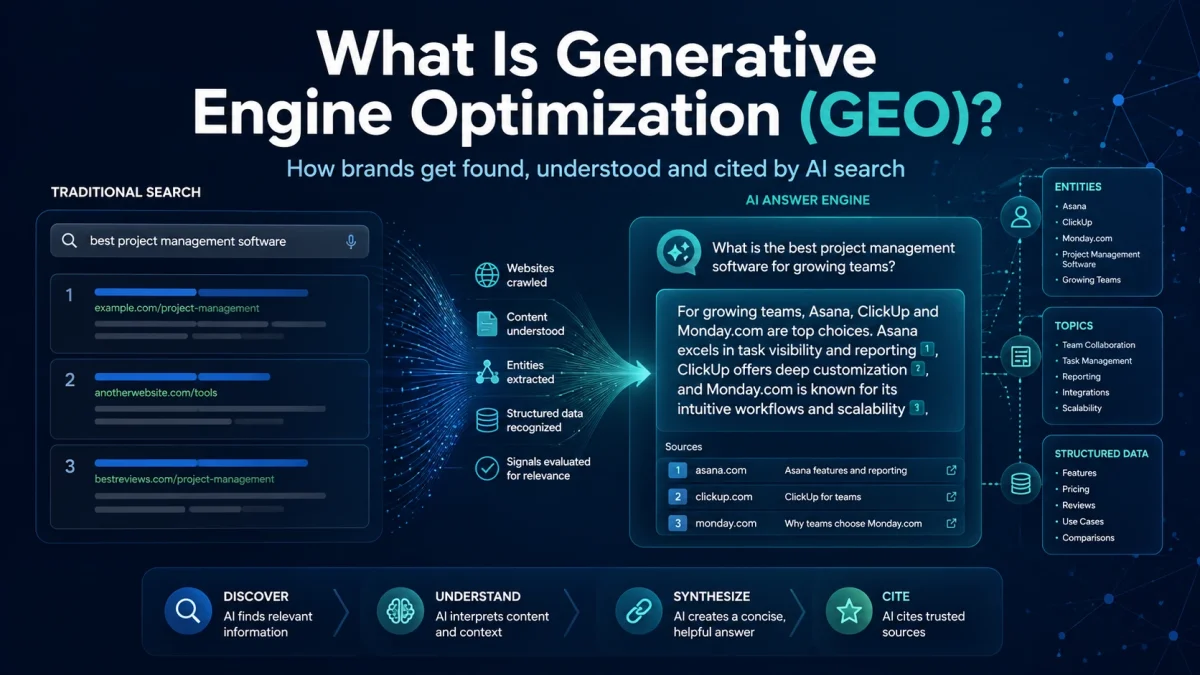
Generative Engine Optimization, usually shortened to GEO, is the process of improving the likelihood that a business, brand, product or website will be found, understood, mentioned and cited by AI-powered search and answer engines.
These include ChatGPT, Google AI Overviews and AI Mode, Gemini, Perplexity, Claude and Microsoft Copilot.
Traditional search engines usually return a list of links. Generative engines work differently. They gather information from multiple sources, interpret the question and produce a direct answer.
That changes the nature of online visibility.
It is no longer enough to ask whether your website ranks on the first page of Google. You also need to ask whether an AI system knows that your company exists, understands what it does, describes it accurately and regards your website as a credible source.
You need to know whether your business appears when someone asks for recommendations, comparisons, suppliers or expert advice.
That is what GEO is concerned with.
How does generative search differ from traditional search?
A traditional search engine gives the user a selection of pages to visit. The user reviews the results, chooses a link and looks for the answer on the website.
A generative engine attempts to provide the answer itself.
It may still include links and citations, but the user often receives a substantial amount of information before visiting any external website.
That distinction matters.
In traditional search, visibility has largely been measured through rankings, impressions, clicks and organic traffic. Those measurements remain important, but they do not tell you whether a business is visible inside an AI-generated answer.
A company may rank reasonably well in Google and still be absent from ChatGPT or Perplexity when users ask questions related to its market.
The reverse can also happen. A business may be mentioned in an AI-generated response because it has strong third-party coverage, a recognised brand, useful original research or clear product information, even when its own website is not the highest-ranking result.
GEO therefore looks beyond the position of an individual webpage. It considers the wider body of information that AI systems may use to understand a subject or form an answer.
Where did the term GEO come from?
The term Generative Engine Optimization gained wider recognition following the publication of the research paper GEO: Generative Engine Optimization in November 2023.
The researchers described GEO as a framework for improving the visibility of content within responses produced by generative engines.
Their experiments found that changes to content could affect how prominently a source appeared in generated answers. They also found that there was no single technique that worked equally well in every subject area.
That remains an important point.
GEO is not a checklist of tricks that guarantees a citation. Different answer engines use different retrieval systems, indexes, models and source-selection methods.
Their responses can also vary according to the wording of a question, the user’s location, current information and the sources available.
This makes GEO less predictable than established SEO. It does not make it unmeasurable.
Is GEO replacing SEO?
No. GEO is not replacing SEO.
A website that cannot be crawled, indexed or understood by a search engine is unlikely to perform consistently in AI-powered search either.
Google has said that its established SEO guidance continues to apply to AI Overviews and AI Mode. These features still draw heavily on Google’s search index and ranking systems.
Good technical SEO therefore remains part of GEO. Pages still need to load properly, use sensible internal links, communicate their subject clearly and avoid blocking the systems that need to access them.
The difference is that GEO extends the work.
SEO has traditionally concentrated on helping a page rank for a search query. GEO also considers whether the information on that page can be extracted, interpreted, compared with other sources and used confidently in a generated answer.
In practical terms, SEO helps a page become discoverable. GEO helps the information become usable.
There is a considerable overlap between the two, but they are not the same thing.
What are generative engines looking for?
There is no published master formula covering every generative platform. Anyone claiming to have one should be treated with caution.
However, there are clear qualities that make information easier for both search systems and AI answer engines to use.
Clear information
A page should make its purpose obvious.
The business name, product, service, location, audience and area of expertise should not be buried beneath vague marketing language.
An AI system should not have to infer what a company does from a collection of slogans.
For example, “We transform tomorrow through innovative solutions” says very little.
“We provide managed email-security services for US healthcare organisations” communicates an identifiable entity, service, market and audience.
Clarity is not unsophisticated writing. It is precise writing.
Direct answers
People increasingly search using complete questions rather than short keyword strings.
Content should answer those questions directly.
This does not mean filling every page with repetitive FAQs or reducing complex subjects to one-line responses. It means making sure the answer can be found without forcing the reader, or the retrieval system, to work through several paragraphs of introduction first.
A strong page often begins with a concise answer and then adds explanation, evidence, examples and context.
Evidence and specificity
Unsupported claims are difficult to trust.
Statements such as “industry-leading”, “best-in-class” and “revolutionary” have little value unless they are supported by something tangible.
Useful evidence may include original research, named case studies, product specifications, prices, dates, methodology, author credentials, customer results, independent reviews and recognised certifications.
Specific information gives an answer engine something it can verify and use.
Consistency
A business should be described consistently across its own website and the wider web.
If the company name, services, leadership, location or product descriptions differ from one source to another, an AI system may struggle to decide which version is correct.
Consistency does not mean repeating identical copy everywhere. It means maintaining a stable factual identity.
Authority beyond the company website
Your website is only one part of your online presence.
Generative engines may use news reports, industry publications, academic papers, directories, review sites, social platforms, forums and other third-party sources when constructing an answer.
This is why GEO cannot be treated purely as an on-page content exercise.
Public relations, digital reputation, partnerships, expert commentary and independent mentions can all contribute to how confidently a brand is recognised.
A company describing itself as an expert is marketing. Other credible sources recognising that expertise is evidence.
What does GEO involve in practice?
A practical GEO programme normally starts with measurement rather than rewriting.
The first step is to identify the questions that prospective customers are likely to ask.
These may include:
- Which companies provide a particular service?
- What is the best product for a specific need?
- How does one solution compare with another?
- What does a service normally cost?
- Which providers operate in a particular location?
- What are the risks, benefits or alternatives?
- Who are the recognised experts in the field?
Those questions should then be tested across relevant AI platforms.
The results reveal whether the company is mentioned, which competitors appear, what sources are cited and whether the information presented is accurate.
From there, the work may involve fixing technical access and indexing problems, clarifying the company’s products and services, creating content that answers genuine customer questions, strengthening author and organisational credibility, adding appropriate structured data, publishing original research, correcting inconsistent information and earning relevant third-party mentions.
The right work depends on what the initial analysis uncovers.
Publishing more content is not always the answer.
A website may already have enough content but present it poorly. Another business may have excellent pages but almost no independent recognition. A third may be well known but described inaccurately by AI systems.
GEO should respond to the actual weakness rather than applying the same prescription to every site.
Can you guarantee that a company will appear in ChatGPT?
No reputable GEO provider should guarantee that a company will appear in a particular answer.
Generative responses are dynamic. They can change when a question is reworded, when new sources become available, when an engine changes its model or retrieval process, or when the system decides that a different combination of evidence better answers the question.
The realistic objective is to improve the signals that make a company more likely to be retrieved, understood and trusted.
That can be measured through repeated testing across a defined set of commercially relevant prompts.
Useful GEO measurements include how frequently the brand is mentioned, how often it is recommended, its position within generated lists, the accuracy of the description, the context of the mention, whether the company website is cited and which third-party sources influence the answer.
AI visibility should be monitored over time rather than judged from one isolated prompt.
Does GEO mean writing content for machines?
It should not.
Good GEO content is useful to people first.
The same qualities that help an answer engine use a page, such as clarity, structure, specificity, evidence and direct answers, also make the page easier for a human reader to understand.
Problems arise when companies attempt to manufacture authority, produce large volumes of thin content or stuff pages with artificial questions and answers purely to influence AI systems.
Google has warned that using generative AI to create large numbers of pages without adding genuine value may breach its spam policies.
The goal is not to make content sound as though it was written for a machine. The goal is to remove ambiguity and provide information worth using.
Why does GEO matter now?
AI-assisted search is becoming part of everyday research and purchasing behaviour.
People use generative tools to compare products, identify suppliers, research unfamiliar subjects, shortlist services and ask questions that previously required several separate searches.
ChatGPT search can search the live web and return answers with links to relevant sources. Google’s AI search features similarly combine generated responses with supporting websites.
For businesses, the important change is not simply that another search platform has appeared.
The change is that an AI system may now decide which companies, products and sources are included in the answer before the user visits a website.
A business that is absent from that answer may never enter the customer’s consideration.
How should a business begin with GEO?
Begin by finding out what AI systems currently say.
Choose a manageable set of questions that reflect real customer intent. Test them across the platforms your audience is likely to use. Record which businesses are mentioned, which sources are cited and where the answers are incomplete or inaccurate.
Then examine why the visible companies are being selected.
Do they provide clearer information? Are they discussed by credible third parties? Do they publish useful research? Are their products easier to compare? Is their expertise more clearly demonstrated?
That analysis creates a practical starting point.
GEO is still developing, and the systems involved will continue to change.
The underlying requirement, however, is unlikely to disappear.
Businesses need to make reliable information about themselves easy to find, easy to understand and worth citing.
That is what Generative Engine Optimization is for.