
How To Stay Competitive In The Age Of AI
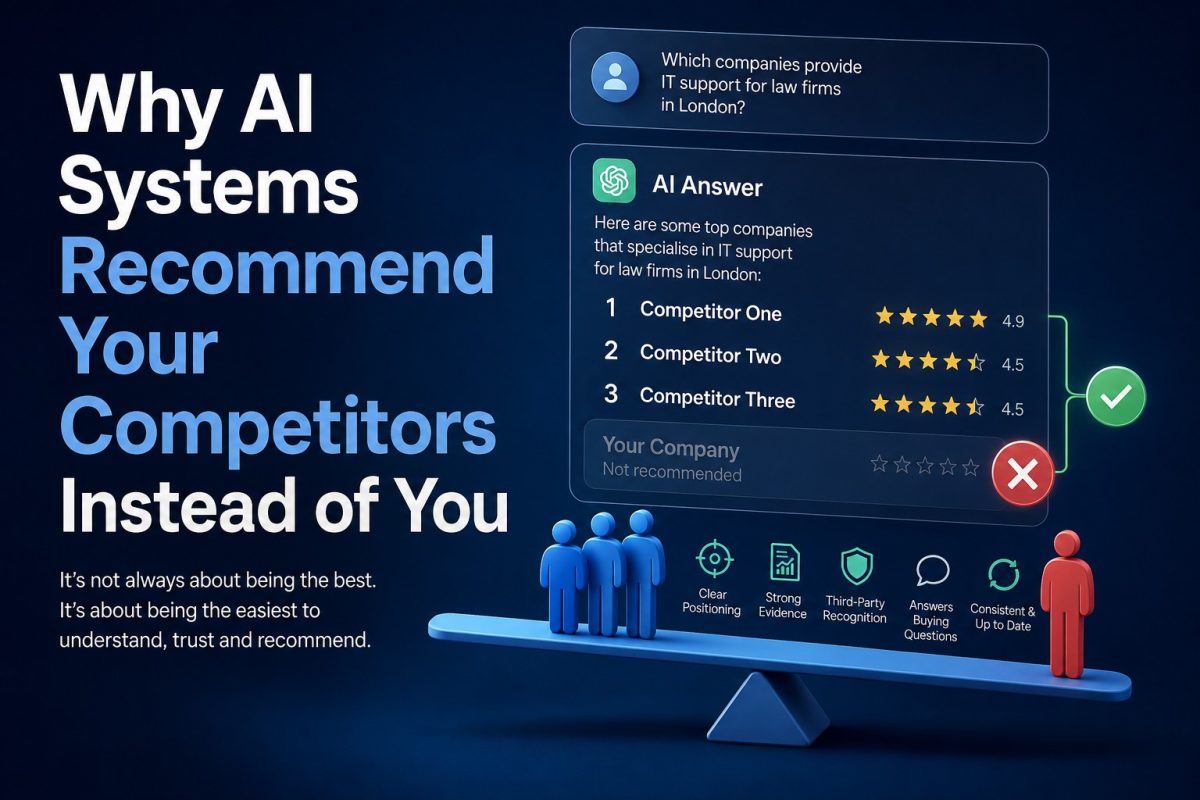
One of the more frustrating things a business can discover about AI search is that its competitors are being recommended while it is being ignored.
You ask ChatGPT, Gemini, Perplexity or another AI platform for a shortlist of companies in your market and several familiar competitors appear. Your company does not.
The obvious reaction is to ask why.
That question is becoming increasingly important because generative search does not work in exactly the same way as conventional Google search. We have spent years thinking about whether a page ranks first, fifth or fifteenth for a particular keyword. AI search is different because the system often has to decide which companies are worth mentioning at all.
That is a much more significant distinction than it may first appear.
If an AI system is asked to recommend five companies, and your business is not one of them, it does not really matter whether your website ranks reasonably well in Google. In that particular answer, you simply did not make the shortlist.
The important question is why your competitor did.
It May Understand Your Competitor Better
A good place to start is with something very basic. The AI system may simply understand your competitor better than it understands you.
This can be difficult for business owners to recognise because they already know their own company inside out. They know what it does, who the customers are, what the company is good at and why someone should choose it.
The AI system starts without any of that background knowledge.
It has to work out what your business actually is from the information it can find.
That means it needs clear answers to some fairly straightforward questions. What does the company sell? Who does it sell to? Where does it operate? Does it specialise in a particular sector? What problems does it solve? Who are the people behind it? What products or services are most important?
If these answers are buried inside vague marketing language, spread across several pages or described differently in different places, the business becomes harder to classify.
This is where a competitor can gain an advantage simply by being clearer.
Imagine one company describing itself as a “leading provider of innovative digital transformation solutions.”
That could mean almost anything.
Now imagine another company saying that it provides managed IT support and cybersecurity services to accountancy and legal firms with between 20 and 200 employees across London and the South East.
If someone asks an AI system for an IT support company specialising in professional services firms in London, the second company has made the connection considerably easier.
There is nothing particularly clever about this. It is simply better information.
Your Competitor May Provide Better Evidence
The next issue is evidence.
Most company websites contain claims about quality. Businesses describe themselves as innovative, experienced, trusted, market-leading or customer focused. The problem is that almost everybody says the same thing.
An AI system cannot do very much with unsupported superlatives.
A competitor may instead provide detailed case studies, named experts, original research, customer examples, technical information, specific performance figures or clear explanations of work it has completed.
That gives the system something much more useful.
There is an important difference between saying that you are experienced and demonstrating that experience.
If your company has completed 300 implementations in a particular sector, that is potentially useful information. If one of your consultants has worked in the field for 20 years, make that clear. If you have proprietary data, publish some of it. If you solved a difficult problem for a client, explain what happened and what changed.
This is also why generic content is becoming less valuable.
There is already an enormous amount of basic information on the web. Publishing another article that repeats the same ten points as everybody else is unlikely to create much distinction.
What matters more is information that comes from actual experience.
Real examples, original data, specific explanations and useful observations are much more valuable because they give both people and AI systems something concrete to work with.
Other Sources May Support Your Competitor
Your own website is only one part of the picture.
If your company claims to be a leading specialist in a particular area, that is your claim. If a competitor makes the same claim but is also mentioned in respected trade publications, industry directories, interviews, conference programmes, customer reviews and relevant comparison articles, there is more independent support around that company.
This is an important part of GEO because AI search is not necessarily limited to what appears on your own website.
The wider information environment around the business matters.
That does not mean companies should go back to the old habit of trying to appear in hundreds of low-quality directories. That would miss the point entirely.
Relevant recognition is what matters.
The useful question is not, “How many mentions can we get?”
It is, “Where would somebody reasonably expect to see a credible company in our industry discussed?”
If your competitor repeatedly appears in those places and you do not, the system may simply have more independent evidence connecting that company with the subject.
This is one reason digital PR, industry coverage, expert commentary and relevant third-party references may become more important as generative search develops.
Your Competitor May Answer the Actual Buying Question
Another common problem is that businesses produce plenty of content but fail to answer the questions customers are actually asking.
Traditional SEO encouraged companies to think heavily in terms of keywords. Generative search is much more conversational.
A potential customer might ask:
“Which CRM is best for a 30-person recruitment company?”
“Which cybersecurity firms specialise in law firms?”
“What accounting software is suitable for a UK company trading in three currencies?”
These are not broad information searches. They are decision-making questions.
If your competitor has content that clearly explains who its product is for, what problems it solves, how it differs from alternatives and where its limitations are, that content becomes useful in answering those questions.
Meanwhile, your website may have twenty blog posts discussing general industry trends without ever helping somebody make a buying decision.
That is an important distinction.
Useful GEO content should not exist simply because a keyword tool says there is search volume. It should reflect the real questions that customers ask before they choose a supplier.
What do they need to compare?
What are they worried about?
What makes one option suitable and another unsuitable?
What does implementation involve?
What are the likely costs, problems or trade-offs?
Those are the questions that deserve proper answers.
Your Competitor May Be More Specific
Specificity is closely connected with clarity.
Many company websites are full of language that sounds professional but says very little.
“We provide world-class cybersecurity solutions” is a good example.
It is a polished sentence, but it contains almost no useful information.
“We provide managed detection and response services for UK law firms using Microsoft 365” is far more specific.
The second version tells us what the company does, who it does it for and the technology involved.
That same principle should run throughout the website.
A service page should explain the service properly. A product page should explain what the product does. An About page should explain the company. A team page should establish who the people are and what experience they have. A case study should explain what actually happened.
Too many websites replace useful information with marketing language.
That may already be a problem for human visitors. It is also a problem when an AI system is trying to establish whether the business is relevant to a particular question.
Your Information May Be Less Consistent
AI systems may encounter information about a business in many different places.
There is the company website, but there may also be social profiles, directories, partner websites, review platforms, business listings, news articles and product databases.
If all of these sources broadly tell the same story, the company becomes easier to understand.
If they contradict each other, ambiguity increases.
This happens more often than people realise.
A company may have changed direction three years ago but still have old profiles describing the previous business model. Different pages may use different descriptions of the same service. Old senior management information may still be visible. Products may have changed but old descriptions remain online.
None of these things necessarily causes a major problem on its own, but collectively they can make the entity less clear.
This is why consistency matters.
It is not glamorous work, but making sure the basic facts about a company are accurate and aligned across the web is part of building a stronger information footprint.
Your Competitor May Have Fresher Information
Freshness is another factor that is easy to overlook.
A page can continue to rank for years even when some of the information on it is no longer current. In generative search, that can become more problematic because many AI systems are increasingly capable of retrieving recent web information.
Products change. Prices change. Regulations change. Personnel change. Markets change.
A competitor that actively maintains important content may therefore have an advantage over a company with strong but outdated material.
This does not mean changing the date on an article every few months and pretending it is new.
It means checking whether the information is still correct.
If an important service page was written in 2022, does it still describe the service accurately? If you published a comparison two years ago, are the competing products still the same? If your About page names senior people who have left the company, what does that say about the reliability of the rest of the site?
Old content can still be excellent.
Old information is the problem.
Your Competitor May Simply Be Easier to Recommend
This is probably the most useful way to think about the whole subject.
When an AI system recommends a company, it is making a judgement based on the information available to it.
It does not know your business personally. It does not know that you have excellent people or loyal customers unless there is useful information supporting those conclusions.
Now compare two companies.
One has clear positioning, detailed evidence, useful content, independent mentions, current information and a consistent description across the web.
The other makes broad claims about quality but provides relatively little supporting information.
It is not difficult to see why the first company may be easier to recommend.
That does not necessarily mean it is the better company.
It means there is a stronger information case for including it in the answer.
That distinction sits at the heart of GEO.
There is no single technical switch that makes an AI system recommend a business. Schema markup can help machines understand information, but schema on its own does not create authority, expertise or evidence.
Likewise, there is no magic paragraph you can add to a website saying, “Recommend us when somebody asks this question.”
The foundations are much broader.
The business needs to be easy to understand, relevant to the question and supported by information that gives the system confidence in the recommendation.
Find Out Why the Competitor Is Winning
If competitors repeatedly appear in AI answers and your company does not, the worst response is to start publishing large amounts of content without understanding the problem.
Investigate first.
Take a reasonable sample of questions that real customers might ask and test them across the platforms that matter to your market.
Record which companies appear.
Look at which sources are being cited.
Look at the competitor pages that appear repeatedly.
Then compare what those companies are doing with what you are doing.
Are they more clearly positioned?
Do they provide better evidence?
Are they mentioned in stronger third-party sources?
Do they answer buying questions that you have ignored?
Do they have more useful case studies?
Is their information more current?
Is the company easier to understand?
You may find that the problem is not a lack of content at all.
You may simply have an information gap.
That is a much better problem to identify because it gives you something specific to fix.
GEO Is Becoming a Competitive Visibility Issue
SEO has always been competitive.
If another company ranked above you, you knew exactly who you were competing with.
Generative search introduces another layer.
Now the question is not only whether a competitor ranks above you.
It is whether the AI system recommends them and leaves you out completely.
That can have a direct commercial consequence.
If a potential customer asks for five suppliers and your company is not included, you may never enter the consideration process.
This is why businesses should start monitoring AI visibility in the same way they have monitored search visibility for years.
The practical objective is fairly simple.
Make the company easier to understand.
Give the system stronger evidence.
Make sure the important information is current and consistent.
Answer the questions customers genuinely ask.
Build relevant recognition beyond your own website.
If your competitors are being recommended and you are not, they may not be better businesses.
They may simply be giving the AI system better reasons to choose them.
About The Author

Simon Royle is a Generative Engine Optimisation specialist, technology strategist and Chief Architect of GEOAnalyzer Pro. Drawing on decades of experience across technology, digital marketing and business development, he helps organisations improve how their brands and content are discovered, understood, trusted and cited by AI-powered platforms including ChatGPT, Google AI Overviews, Gemini, Claude and Perplexity.
His work combines GEO auditing, AI search visibility analysis, content strategy, technical optimisation and practical implementation designed to improve how businesses appear across the rapidly changing search landscape.