
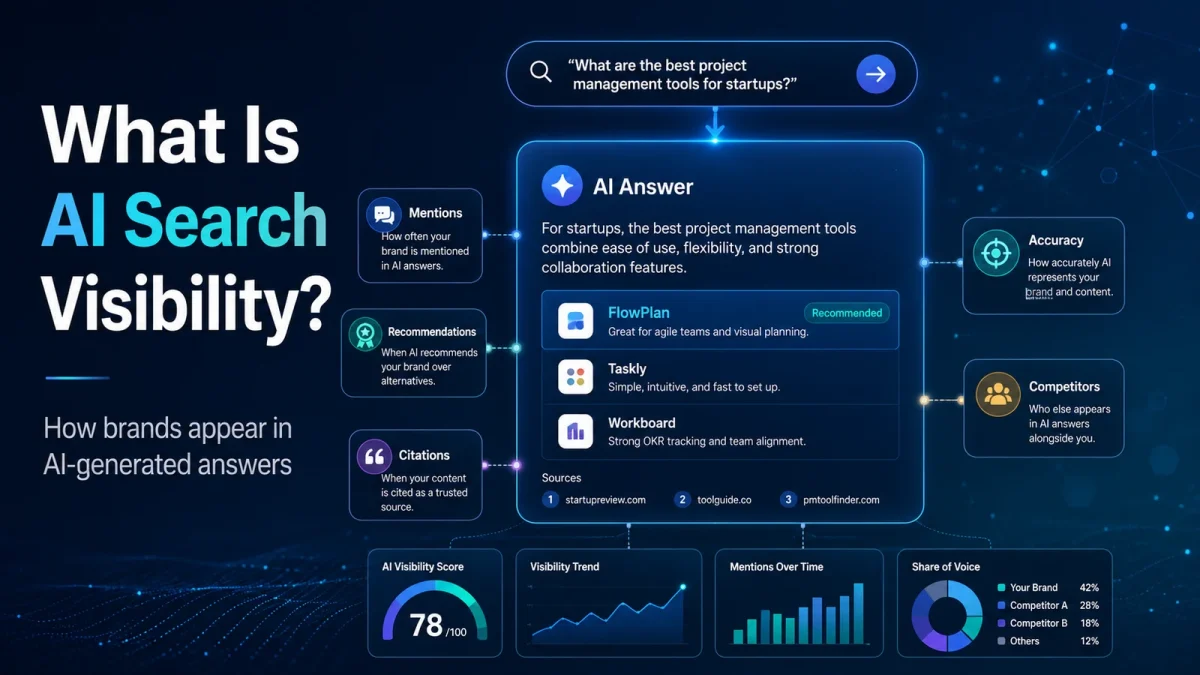
AI search visibility is the extent to which a person, business, brand, product or website appears in answers generated by artificial intelligence systems.
These systems include ChatGPT, Google AI Overviews, Gemini, Perplexity, Claude and Microsoft Copilot.
Traditional search visibility is usually measured through rankings, impressions, clicks and website traffic.
AI search visibility is different.
It asks whether an AI platform knows that your organisation exists, understands what it does, describes it accurately and includes it when answering relevant questions.
A business may rank well in Google and still be absent when somebody asks an AI system for a recommendation. Another business may appear regularly in AI-generated answers even when its website does not hold the highest traditional search position.
This is why businesses need to measure more than rankings.
They need to know whether they are part of the answer.
The short explanation
AI search visibility measures how often, how prominently and how accurately a business or source appears in AI-generated answers.
This can include:
- being mentioned by name
- being recommended
- being compared with competitors
- having a website cited as a source
- having products or services described accurately
- being recognised as an expert or authority
Visibility is not simply a matter of appearing somewhere in an answer.
A business mentioned as a leading option has greater visibility than one listed briefly at the end of a long response. A company described accurately has better visibility than one included with outdated or incorrect information.
How search visibility has changed
For many years, online visibility was mainly about appearing on a search results page.
A person entered a question or keyword into Google. The search engine returned a list of links. The person selected one and visited a website.
Businesses measured this through keyword rankings, impressions, click-through rates, organic traffic, enquiries and sales.
Those measurements still matter.
The difference is that many search experiences now provide a substantial answer before the user visits a website.
Someone may ask:
- Which accounting firms specialise in technology companies?
- What is the best email-security platform for a small healthcare provider?
- Which bicycle brands make reliable commuter bikes?
- Who are the recognised experts in Generative Engine Optimisation?
An AI system may respond with a summary, shortlist, comparison or direct recommendation.
The businesses included in that response have visibility. Those left out do not, even if they rank for related keywords.
What does AI search visibility look like?
Brand mentions
The simplest form is a direct mention.
A user asks for companies operating in a particular market, and the AI system includes your company in its response.
This shows that the platform has some awareness of the business and associates it with the subject. It does not necessarily mean that the platform understands the company correctly.
Recommendations
A recommendation is more commercially significant.
The system may include a company when someone asks for the best provider, the most suitable product or a shortlist of options.
For example:
Which Cambridge companies sell refurbished bicycles?
A business appearing in that answer has been recognised as relevant to the request.
Citations
Some AI platforms provide links or citations showing where information came from.
A citation can send a reader directly to a company’s website. It can also indicate that the platform considers the page useful evidence for the answer.
The brand being discussed and the source being cited are not always the same.
An AI system might discuss one company while citing an independent article, directory or review site. Businesses should therefore measure both mentions and citations.
Product and service recognition
A platform may know a company’s name but misunderstand what it offers.
Good AI search visibility means that the system correctly connects the organisation with its products, services, customers and areas of expertise.
Simply being recognised as a general technology company, for example, may not be enough if the company wants to be known specifically for email security or phishing protection.
Expert recognition
AI systems also answer questions about people.
They may be asked to identify specialists, authors, researchers, consultants or industry commentators.
An organisation can improve this form of visibility by making the expertise of its people clear through biographies, books, research, interviews, conference appearances and articles.
Accurate representation
Visibility is not automatically positive.
A business might appear with the wrong location, outdated pricing, an old product name or an inaccurate description. It may even be confused with another company.
Being mentioned incorrectly can be worse than not being mentioned at all.
Accuracy must therefore be part of any serious measurement of AI visibility.
AI visibility is not one universal score
There is no single AI search result.
Different platforms may produce different answers because they use different models, retrieval systems, search indexes and sources.
The wording of the question also matters.
Consider these prompts:
- What are the best email-security platforms?
- Which email-security platform is suitable for small US healthcare providers?
- What are affordable alternatives to Microsoft Defender for email?
- Which companies provide managed DMARC protection?
All four prompts concern email security, but they express different needs.
A company may appear for one question and not another.
Results may also change according to location, date, conversation context, whether web search is enabled and which sources are currently available.
A single test cannot establish whether a business has strong AI visibility.
Measurement requires a consistent set of relevant questions tested repeatedly across several platforms.
What should a business measure?
Mention rate
How often does the business appear across a defined set of prompts?
If 50 commercially relevant questions are tested and the company appears in 10 answers, its observed mention rate is 20 per cent for that test set.
This does not represent every possible search. It creates a repeatable benchmark that can be measured again later.
Citation rate
How often is the company’s website cited as a source?
This should be measured separately from brand mentions. A company might be mentioned frequently but rarely cited.
Recommendation rate
How often is the business included when users ask for providers, products, specialists or solutions?
Recommendation prompts are particularly important because they are often closer to a buying decision.
Description accuracy
Does the answer correctly explain what the business does, where it operates, who it serves and what it provides?
Accuracy can be recorded as correct, partly correct or incorrect.
Citation ownership
Which websites are being cited?
Answers may draw from the company website, competitor sites, review platforms, news publications, trade associations, directories, academic sources or government websites.
Understanding which sources influence an answer is one of the most useful parts of GEO analysis. It reveals what the AI system appears to trust.
Competitor share of voice
Which competitors appear most frequently?
If the same businesses repeatedly appear while yours is missing, the next question is why.
They may have clearer product information, stronger third-party coverage, better reviews, original research, stronger authority signals or more consistent information across the web.
Why might a business be invisible?
The business is not clearly defined
A website may rely on vague claims such as “innovative solutions” or “transforming the future”.
These statements do not clearly explain what the organisation does.
The business name, services, location, market and customer base should be stated plainly.
Important information is difficult to find
Critical information may be buried in PDFs, images, old press releases or poorly structured pages.
The website may also lack clear pages for individual products, services, industries or locations.
The website lacks evidence
A company may make strong claims without supporting them.
Useful evidence can include case studies, named results, product specifications, original research, certifications, expert biographies, transparent methodology and independent reviews.
Other sources describe competitors more often
AI systems do not rely only on what a company says about itself.
A competitor with stronger coverage across trusted publications, directories and industry websites may be easier to recommend.
Information is inconsistent
The company name, address, product descriptions, leadership details or service information may differ between websites.
Inconsistency creates uncertainty.
The content does not answer real questions
A website may contain large amounts of marketing copy while failing to answer the questions customers actually ask.
Publishing more content will not solve this unless the content is relevant, clear and useful.
How can AI search visibility be improved?
Make the organisation easy to understand
Clearly explain who you are, what you provide, who it is for, where you operate and what problems you solve.
Do not expect the reader or the AI system to infer these facts.
Build useful subject coverage
Create pages and articles that answer the questions customers ask before making a decision.
Cover definitions, costs, comparisons, risks, alternatives, implementation and suitability.
The objective is not to produce the most content. It is to provide useful and reliable information.
Support claims with evidence
Replace unsupported marketing statements with facts.
Dates, figures, examples, named methodologies and documented results are more useful than claims such as “world-class” or “industry-leading”.
Strengthen external recognition
Look beyond the company website.
Relevant recognition may come from trade publications, professional associations, interviews, podcasts, conferences, research citations, customer reviews and partnerships.
External recognition helps establish that the company is not the only source making claims about itself.
Maintain sound technical SEO
AI search has not removed the need for technical SEO.
Pages should still be crawlable, indexable, properly linked, mobile-friendly and clearly structured.
Measure repeatedly
AI visibility should be monitored over time using the same core prompts, platforms and scoring methods.
Record the prompt, platform, date, response, mentions, citations, accuracy, competitors and sources used.
Without preserving the evidence, it is difficult to know whether visibility has genuinely improved.
Can AI search visibility be guaranteed?
No.
AI-generated answers are dynamic. Platforms change, sources change and the wording of the question affects the result.
What can be done is to improve the probability of inclusion.
A business can make itself easier to find, easier to understand, easier to verify, more relevant to the question and better supported by evidence.
That is a practical and measurable objective.
AI visibility is becoming part of brand visibility
Businesses have always needed customers to know that they exist.
Search engines became one of the main ways that discovery happened. AI answer engines are now becoming another.
The important question is no longer only:
Where does our website rank?
Businesses also need to ask:
Does AI know who we are?
Does it understand what we do?
Does it recommend us when the question is relevant?
Does it cite our website?
Does it describe us accurately?
Does it recommend our competitors instead?
Traditional rankings still matter. Website traffic still matters. Conversions still matter.
They are no longer the complete picture.
Conclusion
AI search visibility is about whether a business is present, correctly represented and trusted within AI-generated answers.
It includes more than mentions. It includes recommendations, citations, accuracy, relevance, authority and the sources used to support the answer.
The first step is measurement.
Until a business checks what AI platforms currently say, it does not know whether it is visible, invisible, misunderstood or being replaced in the answer by competitors.
That is why AI search visibility has become one of the central concerns of Generative Engine Optimisation.
Sources and further reading
- Google Search Central: AI features and your website
- Google Search Central: Creating helpful, reliable, people-first content
- Google Search Central: SEO Starter Guide
- Aggarwal et al.: GEO: Generative Engine Optimization
- GeoAnalyzer Pro: What Is Generative Engine Optimization?
About the author

Simon Royle is a Generative Engine Optimisation specialist, author and cofounder of GeoAnalyzer Pro.
His work focuses on AI search visibility, entity clarity, citation analysis, website trust, content structure, technical SEO, competitive analysis and practical GEO measurement.
Simon is the author of The GEO Success Series:
- How to Build an AI-Ready Website
- How to Build a GEO Trust Bank
- How to Measure Your Visibility in AI Search